Purchase Order
On this page
About this guide
This guide shows purchasing managers, buyers and procurement teams how to create purchase orders in Axolt step by step, screen by screen. It starts with the Salesforce app open in front of you and ends with a purchase order saved and on its way to the vendor.
It covers both ways of working:
- Purchasing on the screen choose the type of purchase, pick the vendor, add products from the catalog, set quantities and prices, check delivery dates and save.
- Intelligent purchasing with Axo ask Axo, Axolt’s purchasing assistant, in your own words or by voice. Axo plans purchases from open demand, recommends vendors, prepares draft purchase orders, creates them when you confirm and emails the PO to the vendor.
How to read this guide
| You see | It means |
|---|---|
| Bold text | A button, field, tab or label exactly as it appears on screen for example Save or Receiving warehouse. |
| Numbered red markers on a screenshot | Each number is explained in the table under the screenshot. |
| “Quoted text” in a conversation | Something you type or say to Axo. Axo understands paraphrases too you don’t need the exact words. |
| Tip, Note, Important and Axo boxes | Shortcuts, background information, things to watch for, and where Axo can do the work for you. |
| ⌘ / Ctrl | Use ⌘ (Command) on a Mac and Ctrl on Windows. |
About the sample data
The screenshots use sample data for Bluepeak Medical Systems, Inc., a fictional medical device distributor based in Denver, Colorado. Vendors such as Keystone Medical Supply, Pacific Coast Components and Great Lakes Biomedical, the employee Jordan Mitchell, and all addresses, prices and order numbers are invented for illustration. Your own screens show your organization’s data, and some fields appear only when your administrator has turned them on.
Part 1 · Getting started
Open the Create Purchase Order screen and find your way around it.
1. Welcome to purchasing in Axolt
One screen for every kind of purchase from a single replacement part to a month of demand-driven buying across several vendors.
The Create Purchase Order screen runs natively in Salesforce, on the same live data as your sales orders, manufacturing orders, stock and vendors. Everything you need to buy well is on one page: the vendor and delivery details, a searchable product catalog with stock and prices, the lines you are buying, and purchasing insights for each product.
Three types of purchase order
| Type | Use it when | What happens |
|---|---|---|
| Standard purchase order | You buy stock or services into one of your warehouses. | Goods are received into the receiving warehouse you choose. Lines come from the catalog, open demand or a vendor quote. |
| Drop ship purchase order | The vendor ships straight to your customer. | A customer (or manufacturer) is required. Lines can come from the customer’s order. Nothing enters your warehouse. |
| Return to vendor (RTV) | You send received goods back for credit or replacement. | Starts from a received standard purchase order. You can’t return more than was received. |
Two ways to work
| Purchasing on the screen | Intelligent purchasing with Axo |
|---|---|
| You choose the vendor, add products from the catalog and set quantities and prices yourself. | You tell Axo what you need “plan my purchases from sales order demand” and review what it prepares. |
| Purchase insights on each line show price history, alternate vendors and open demand. | Axo works out quantities from demand, stock and open purchase orders, and recommends vendors on price and real delivery times. |
| You save when you are ready. | Axo prepares draft purchase orders, creates them when you confirm and emails the PO to the vendor. |
You can mix both at any time. Axo works on the same screen you do: a plan it prepares opens as ordinary draft purchase orders that you can edit like any other, and Axo can answer questions about a purchase order you built yourself.
Before you begin
- Access. Your Axolt administrator gives you access to purchase orders and turns on the Create Purchase Order screen for your user, profile or organization.
- Axo. Axo Chat, Axo Voice and the AI features in this guide (the AI Purchase Planner, vendor quote reading, purchase insights and emailing the PO to the vendor) appear only when Axo AI is enabled for you. When it is off, the screen shows no AI buttons at all everything in Part 2 still works.
- Optional fields. Some fields such as attachments, projects, departments, revisions, payment terms and shipping appear only when they are enabled for your organization.
2. Opening the Create Purchase Order screen
Start from the Salesforce app you use for purchasing. These steps begin with the app already open.
Create a new purchase order
There are two ways to open the screen for a new purchase order:
- From the Purchase Orders tab select New on the Purchase Orders list view, as in the steps below.
- From the Create Purchase Order tab open the App Launcher, search for Create Purchase Order and select it, or select the tab in your app’s navigation bar. The screen opens straight on its start page.
Open the App Launcher (the grid icon at the top left of Salesforce) and search for Purchase Orders. Select it to open the Purchase Orders tab.
On the Purchase Orders list view, select New.
The Create Purchase Order screen opens on its start page, What type of purchase is this? Continue with Chapter 4.
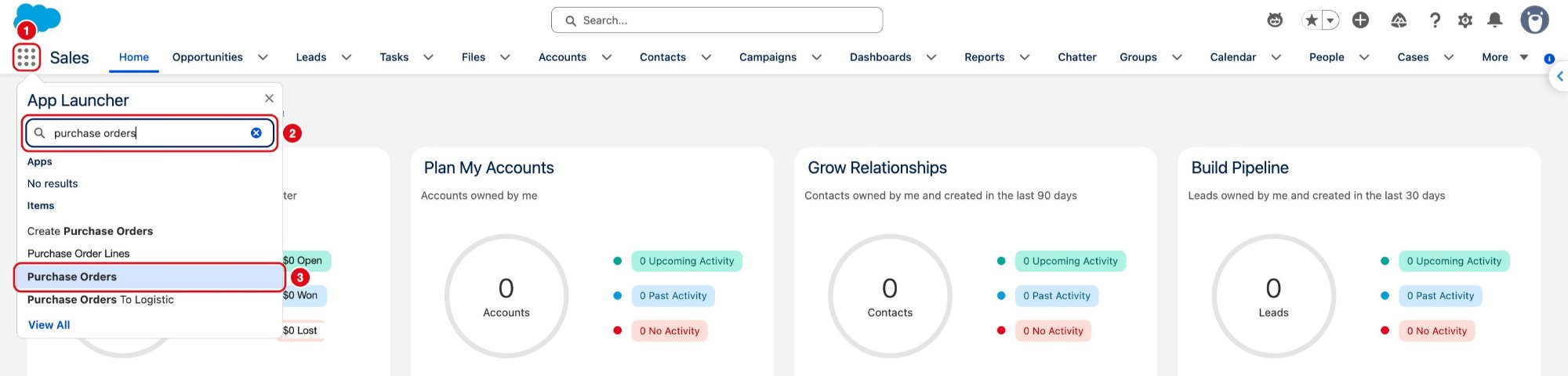
| # | Item | What it does |
|---|---|---|
| 1 | App Launcher | Select the grid icon at the top left of your app. |
| 2 | Search | Type “purchase orders” to find the tab. |
| 3 | Purchase Orders | Select it to open the Purchase Orders tab. |
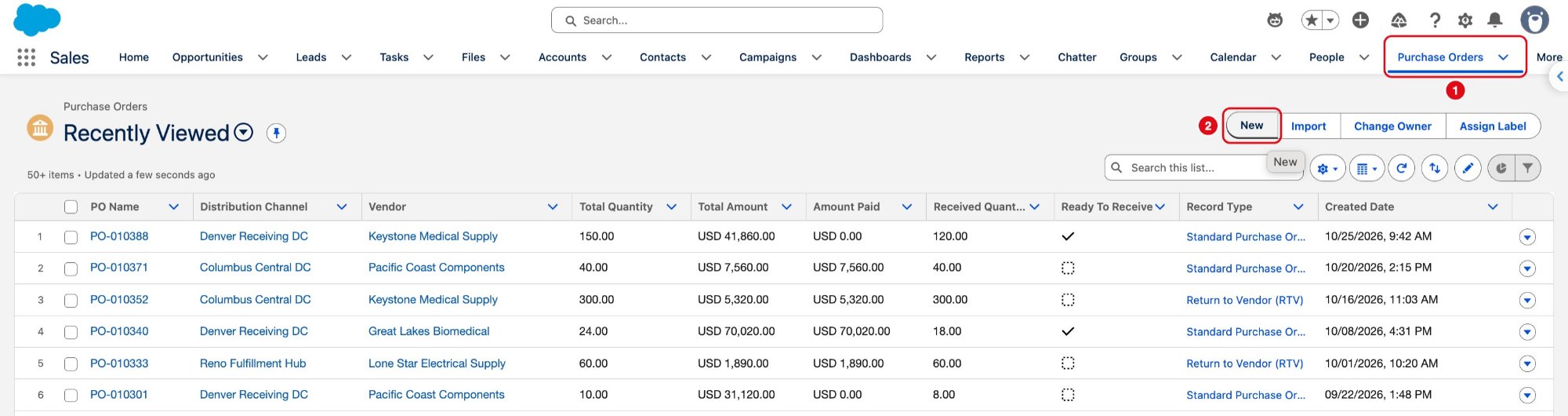
| # | Item | What it does |
|---|---|---|
| 1 | Purchase Orders tab | The tab in your app’s navigation bar. |
| 2 | New | Starts a new purchase order and opens the Create Purchase Order screen. |
Change a purchase order you already created
To keep working on a purchase order in the Create Purchase Order screen with the catalog, purchase insights and Axo open its record page and select Manage PO at the top right. The screen opens already loaded with this purchase order, so you can keep changing it until it is approved. When you go Back or Save, you return to the purchase order record.
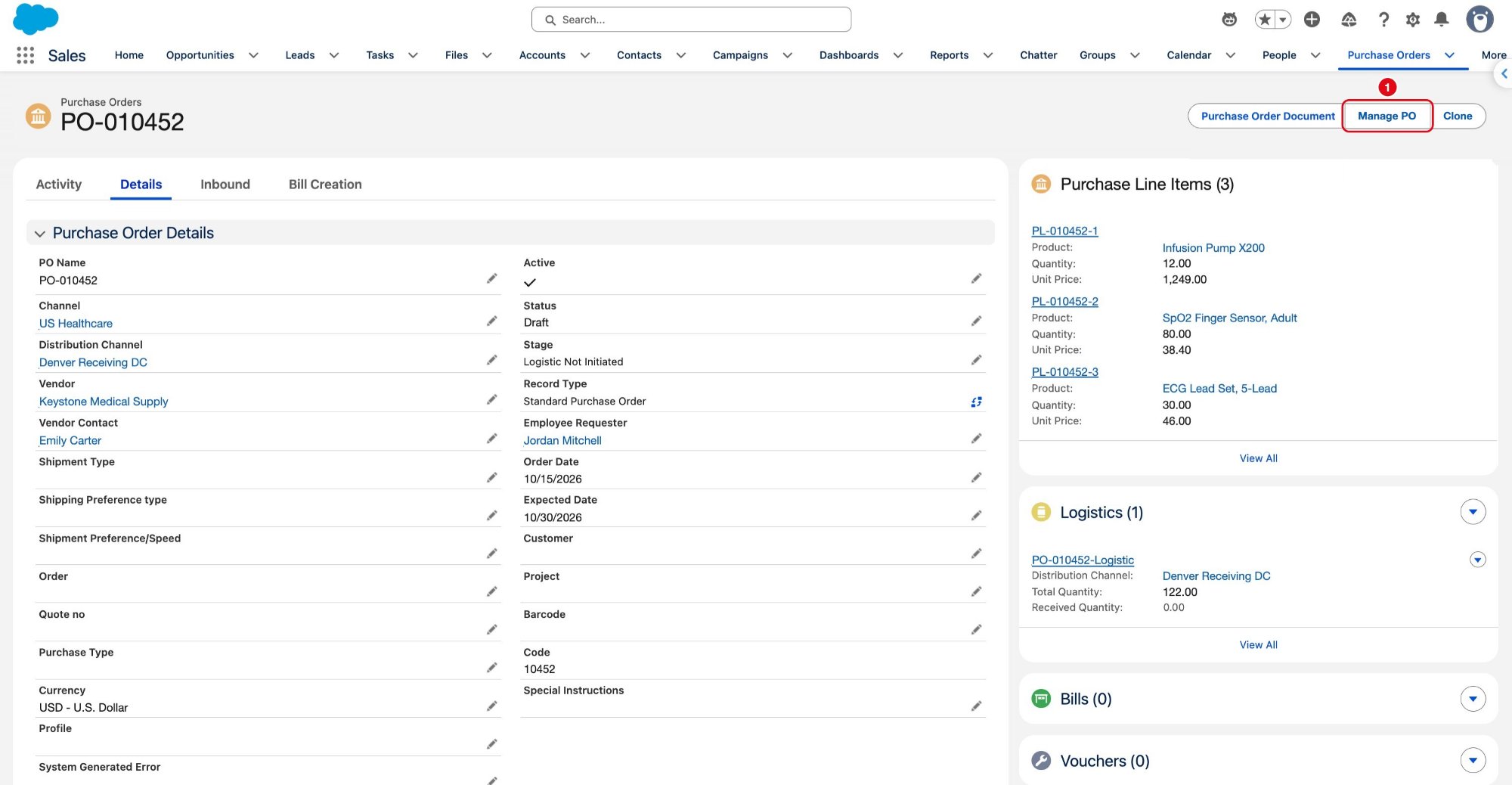
| # | Item | What it does |
|---|---|---|
| 1 | Manage PO | Opens the purchase order in the Create Purchase Order screen, to keep working on it until it’s approved. |
3. A tour of the screen
The screen has two stages: a start page where you choose the type of purchase, and a workspace where you build the purchase order.
The start page
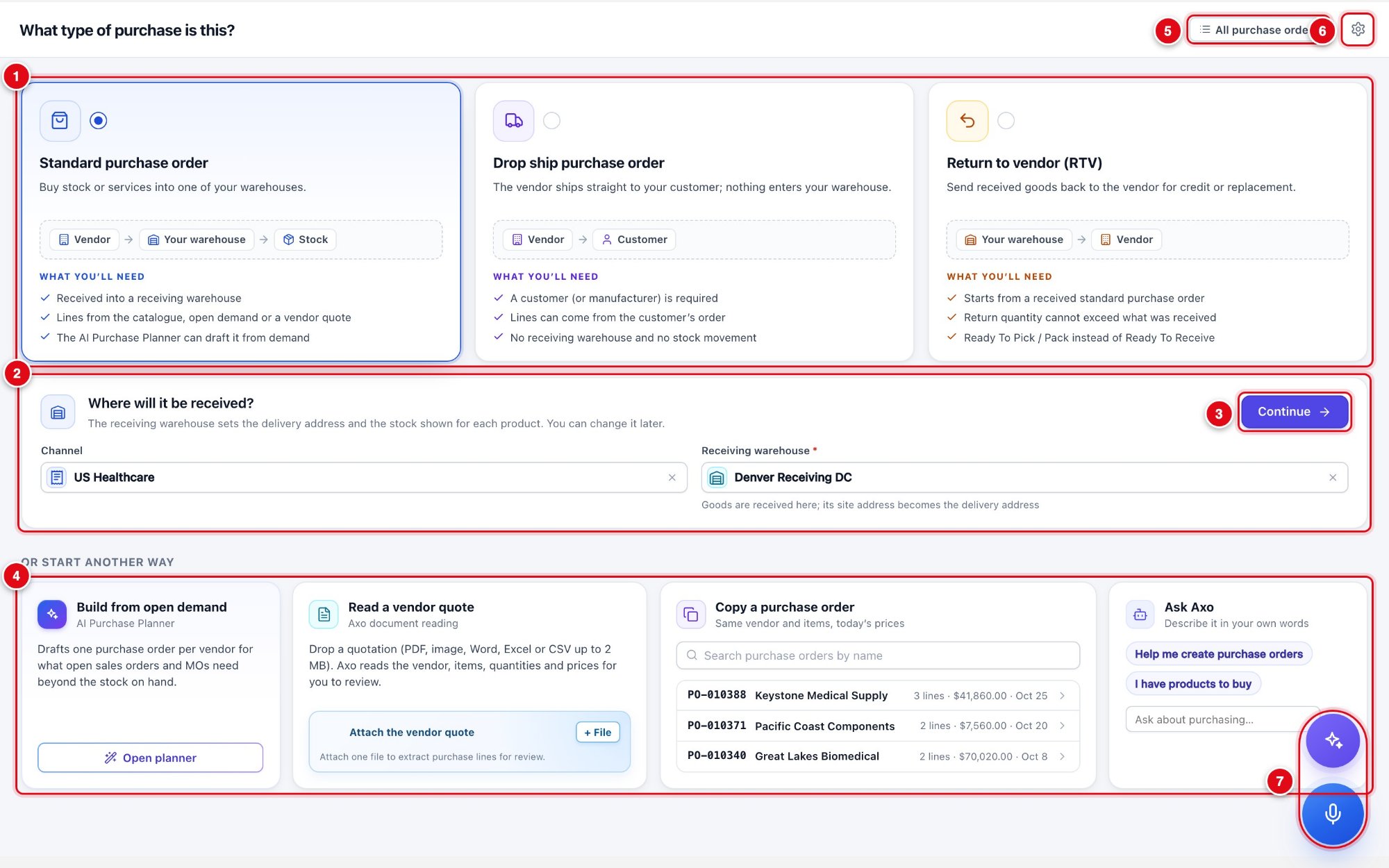
| # | Item | What it does |
|---|---|---|
| 1 | Purchase order types | Standard, Drop ship and Return to vendor. Each card shows the flow of goods and what you’ll need. |
| 2 | Context card | Changes with the type you choose: where goods are received, who receives them, or which received order is going back. |
| 3 | Continue | Opens the workspace for the chosen type. |
| 4 | Or start another way | Build from open demand (AI Purchase Planner), read a vendor quote, copy a purchase order, or ask Axo. |
| 5 | All purchase orders | Opens the Purchase Orders list. |
| 6 | Settings | Keyboard shortcuts, a new purchase order, Axo settings and token usage. |
| 7 | Axo Chat and Axo Voice | Your purchasing assistant, available on every page of the screen. |
The workspace
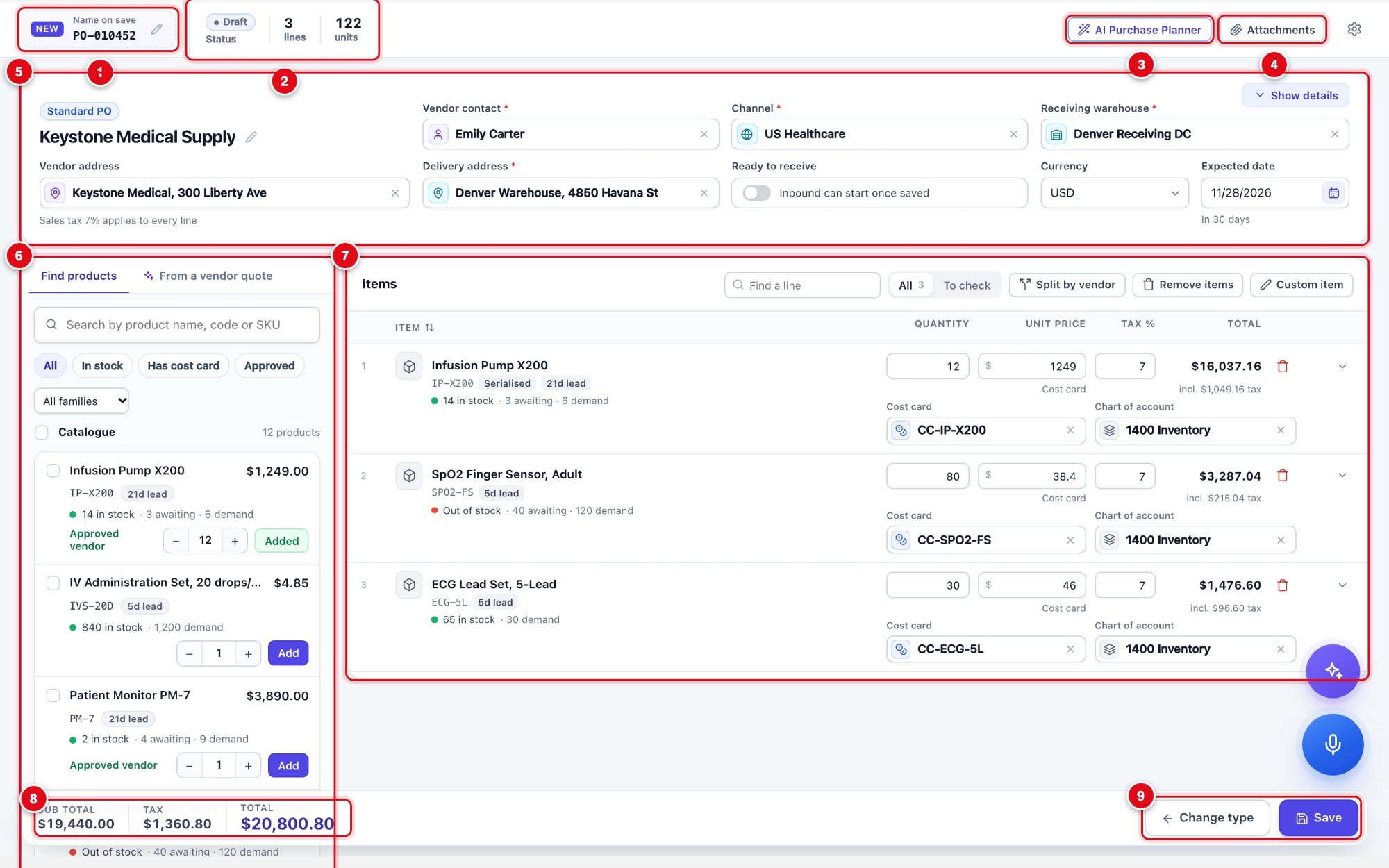
| # | Item | What it does |
|---|---|---|
| 1 | Purchase order name | The number it will get when saved (PO-010452). Select the pencil to choose your own name. |
| 2 | Status and counts | The Status (Draft), the number of lines and the total units. |
| 3 | AI Purchase Planner | Drafts one purchase order per vendor from open demand (Chapter 23). |
| 4 | Attachments | Quotes, specifications or drawings to attach when you save (Chapter 9). |
| 5 | Header | Vendor and delivery details. More fields are behind Show details. |
| 6 | Add products | The product catalog with stock, prices and approved-vendor information, always beside your lines. |
| 7 | Items | The lines you are buying: quantity, unit price, tax, total, cost card and chart of account. |
| 8 | Totals | Sub total, tax and total, always visible at the bottom. |
| 9 | Change type and Save | Go back to the type choice, or save the purchase order (⌘ / Ctrl + S). |
Part 2 · Creating Standard purchase orders step by step
From choosing the type of purchase to a saved purchase order on its way to the vendor.
4. Choose the type of purchase
Every purchase order starts on the start page. Choose the type, confirm where the goods go, and continue.
Select the card for the type of purchase: Standard purchase order, Drop ship purchase order or Return to vendor (RTV). You can also press 1, 2 or 3.
Complete the context card under the cards (see below for each type).
Select Continue, or press Enter.
Standard purchase order: where will it be received?
For a standard purchase order, choose the Channel and the Receiving warehouse. Both start with your own defaults. The receiving warehouse decides where the goods are received, the stock shown for each product, and through its site address the delivery address. You can change all of them later in the workspace.
Drop ship: who receives the goods?

| # | Item | What it does |
|---|---|---|
| 1 | Customer / manufacturer | Required. The vendor delivers straight to this customer. |
| 2 | Customer order (optional) | Choose one of the customer’s orders and its lines are added to the purchase order. |
| 3 | Continue | Opens the workspace with the customer, the order and its lines filled in. |
Return to vendor: which received order is going back?
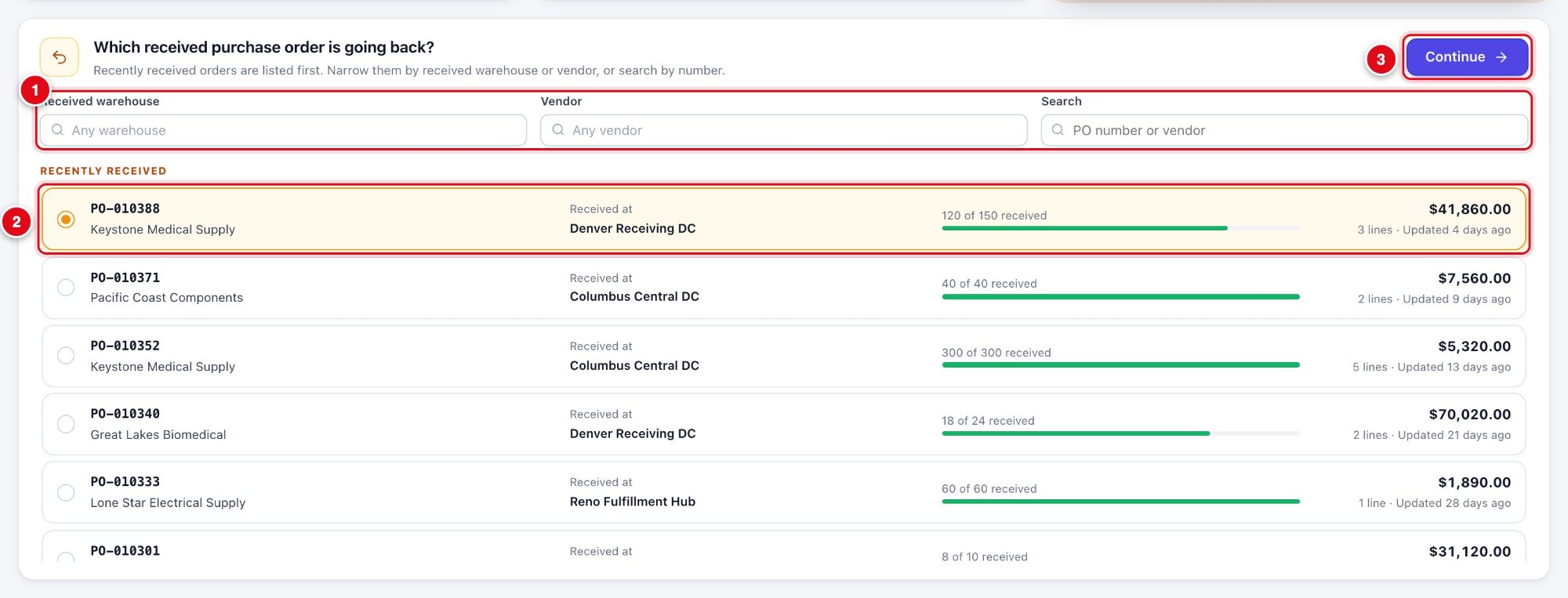
| # | Item | What it does |
|---|---|---|
| 1 | Filters | Narrow the list by received warehouse or vendor, or search by PO number or vendor. |
| 2 | Received purchase order | Recently received orders are listed first, with how much was received, the total and when it was last updated. |
| 3 | Continue | Loads the received lines with the quantities you can return. |
5. Vendor and delivery details
The header holds who you buy from and where the goods go. Required fields are marked with a red asterisk.
Choose the vendor
Select the vendor search box at the top of the header. Your recently viewed vendors are listed right away.
Type part of the vendor’s name to search, then select the vendor. Use the arrow keys and Enter if you prefer the keyboard.
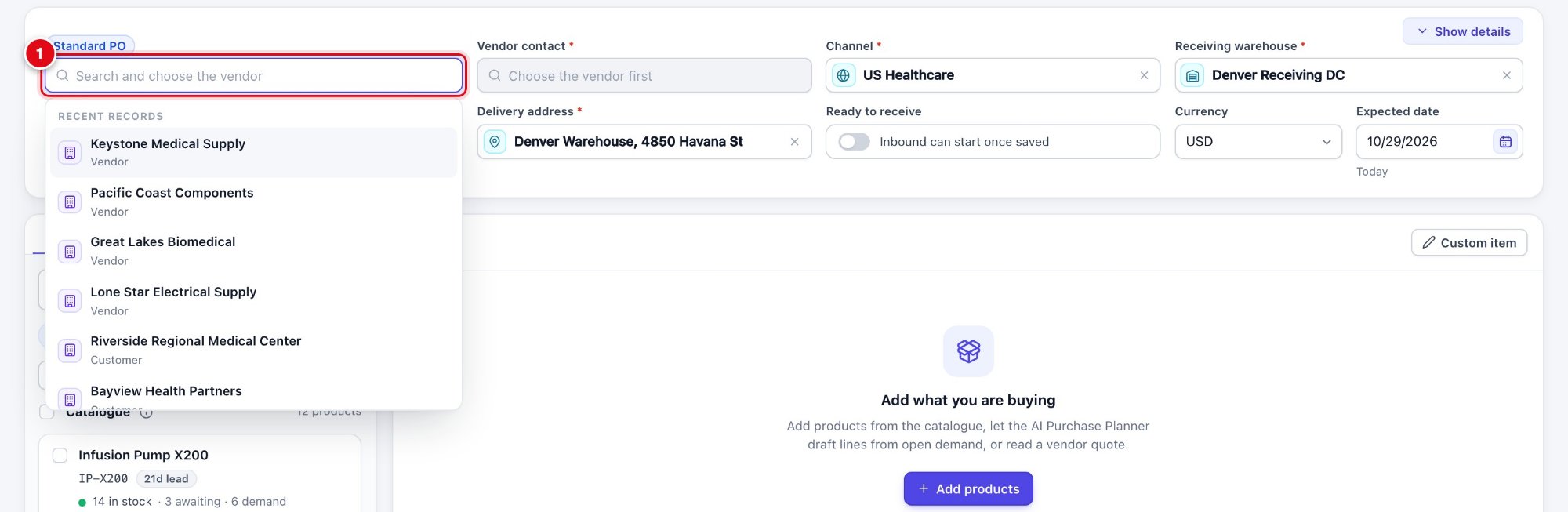
| # | Item | What it does |
|---|---|---|
| 1 | Vendor | Search and choose the vendor. Only vendor accounts are offered. |
When you choose the vendor, Axolt fills in what it knows about them: the Vendor contact, the Vendor address, payment terms, the vendor profile and the sales tax that applies. The catalog switches to the products this vendor is an approved vendor for.
The key fields

| # | Item | What it does |
|---|---|---|
| 1 | Vendor | The vendor’s name links to its record. Select the pencil to change the vendor. |
| 2 | Vendor contact | Who the purchase order is addressed to. Filled in from the vendor. |
| 3 | Channel | The sales channel the purchase belongs to. |
| 4 | Receiving warehouse | Where the goods are received. |
| 5 | Vendor address | The vendor’s address. The note under it shows the sales tax that applies to every line. |
| 6 | Delivery address | Where the vendor delivers the receiving warehouse’s site address by default. |
| 7 | Ready to receive | Turn it on when receiving can start as soon as the purchase order is saved. On a return it is Ready to pick / pack; a drop ship has neither. |
| 8 | Currency | The purchase order’s currency, from your purchasing company. |
| 9 | Expected date | When you expect the delivery. Select anywhere in the field to open the calendar; the note under it says how far away the date is. |
| 10 | Show details | Opens the remaining header fields. |
Check the expected date against lead times
If a product on the purchase order has a lead time longer than the time until the expected date, a warning appears under the header with the earliest realistic date. Select Use <date> to move the expected date to it.

More details
Select Show details to see the rest of the header. If a required field behind Show details is missing when you save, the details open by themselves and the button shows a red count of the problems.
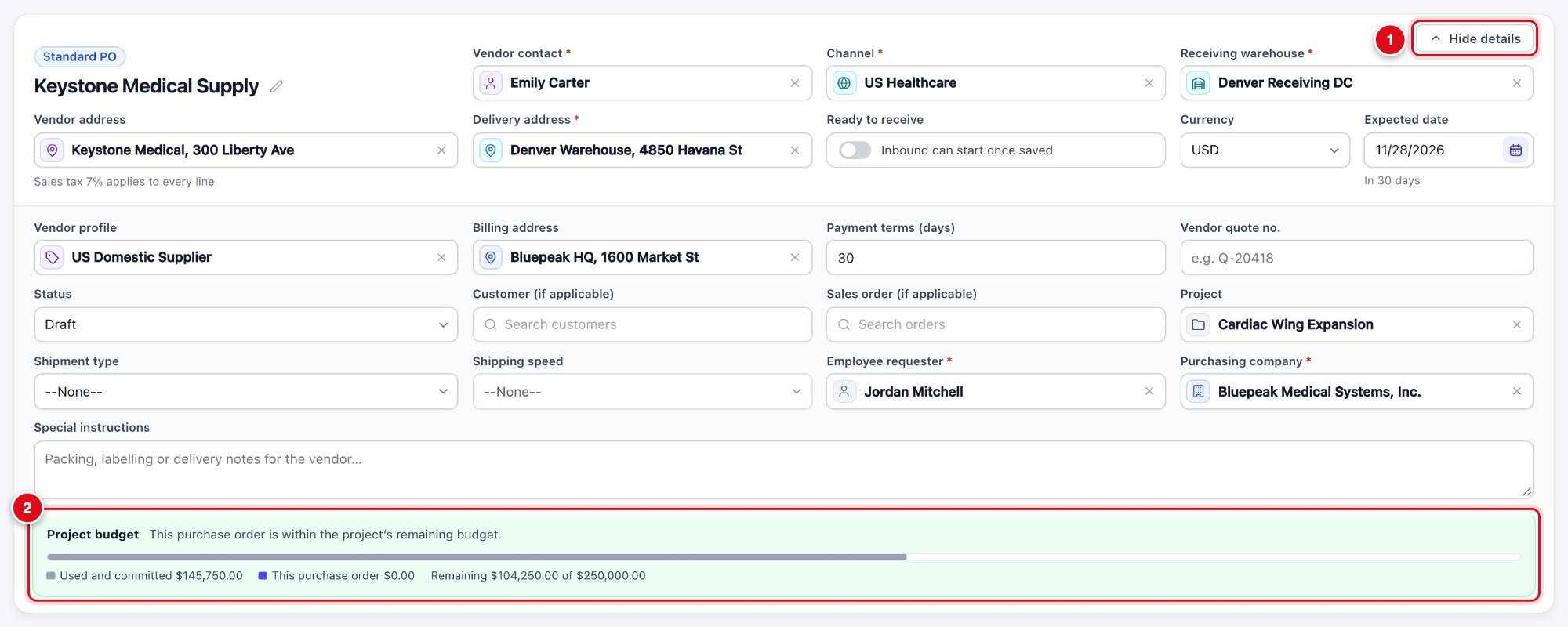
| # | Item | What it does |
|---|---|---|
| 1 | Hide details | Closes the details again. The details are closed whenever you start a new purchase order. |
| 2 | Project budget | When you choose a project, the bar shows the budget already used and committed, this purchase order, and what remains. |
| Field | What it is for |
|---|---|
| Employee requester | Who asked for the purchase. Starts with you. |
| Purchasing company | The company that buys. It sets the purchase order’s currency. |
| Vendor profile | The vendor’s profile, used for tax. Filled in from the vendor. |
| Billing address | Where the vendor sends the invoice. |
| Payment terms (days) | Filled in from the vendor; you can change it for this order. |
| Vendor quote no. | The vendor’s quotation number, for reference. |
| Status | Draft for a new purchase order. |
| Customer and Sales order (if applicable) | Link the purchase to a customer’s order. |
| Project | Shows the project budget bar. |
| Shipment type and Shipping speed | The carrier, then one of its shipping speeds. |
| Special instructions | Packing, labeling or delivery notes for the vendor. |
Name the purchase order
A new purchase order gets the next number in your organization’s series when you save it the top bar shows which (Name on save, for example PO-010452). To use your own name instead:
Select the pencil beside the name in the top bar.
Type the name and press Enter, or select anywhere else. Press Esc to keep the current name.

A name another purchase order already uses is refused straight away, and so is a name that looks like an automatic number. To go back to the automatic number, open the name again and select Use PO-0…. If someone else takes your name before you save, Axolt asks what to do (see Chapter 10).
6. Add products
The Add products panel sits beside your lines. Search the catalog, check stock and prices, and add one product or many at once.
Add a product
Find the product by searching, filtering or browsing. Use Previous and Next at the bottom to page through larger catalogs.
Set the quantity with − and +, or type it.
Select Add (or press Enter in the quantity box). The button turns green and reads Added.
To change the quantity of a product you already added, type the new quantity: the button changes to Update. Select it to set the line’s quantity. Adding a product that is already on the purchase order adds to the existing line rather than creating a second one.
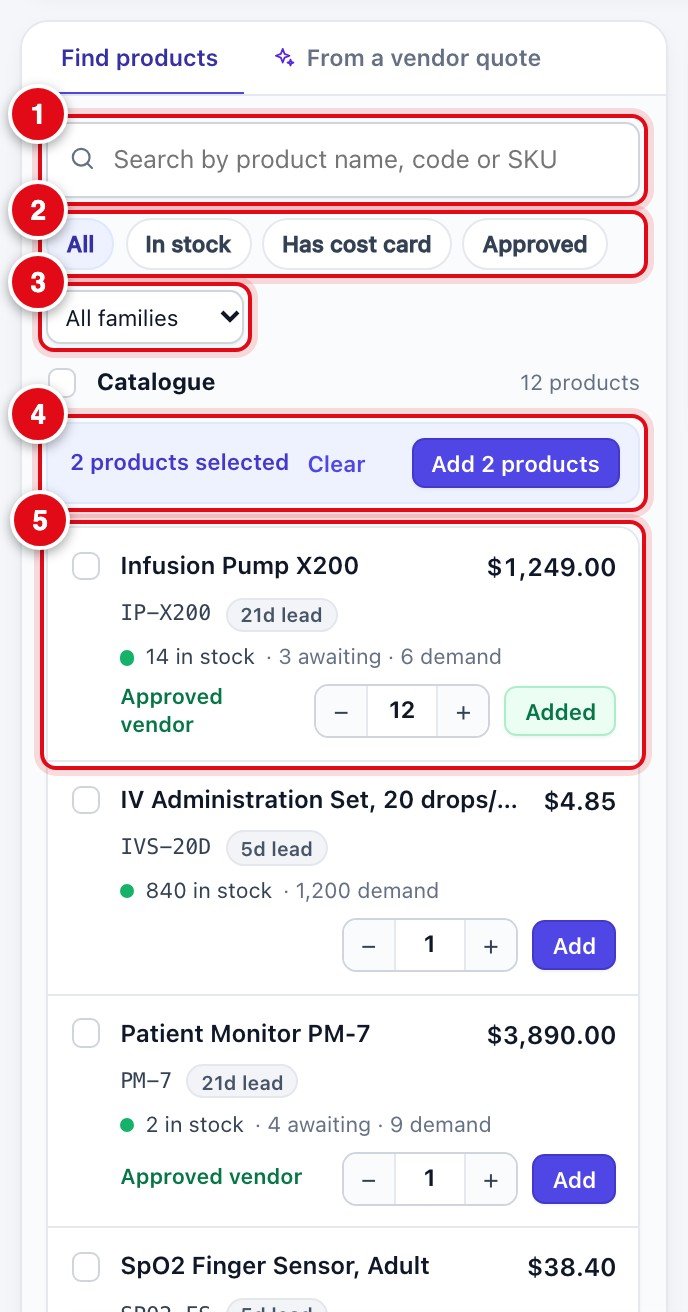
| # | Item | What it does |
|---|---|---|
| 1 | Search | Search by product name, code or SKU. |
| 2 | Quick filters | All, In stock, Has cost card and once a vendor is chosen Approved (products this vendor is an approved vendor for). |
| 3 | Family | Filter by product family. |
| 4 | Selection bar | Appears when you tick products: add them all at once with Add N products, or Clear the selection. |
| 5 | Product | Price from the vendor’s cost card, code, lead time, stock (in stock, awaiting, demand), approved-vendor note, quantity and Add. |
Add several products at once
Tick the box beside each product you want or tick the box in the results header to select every product on the page.
Set each product’s quantity.
Select Add N products in the selection bar.
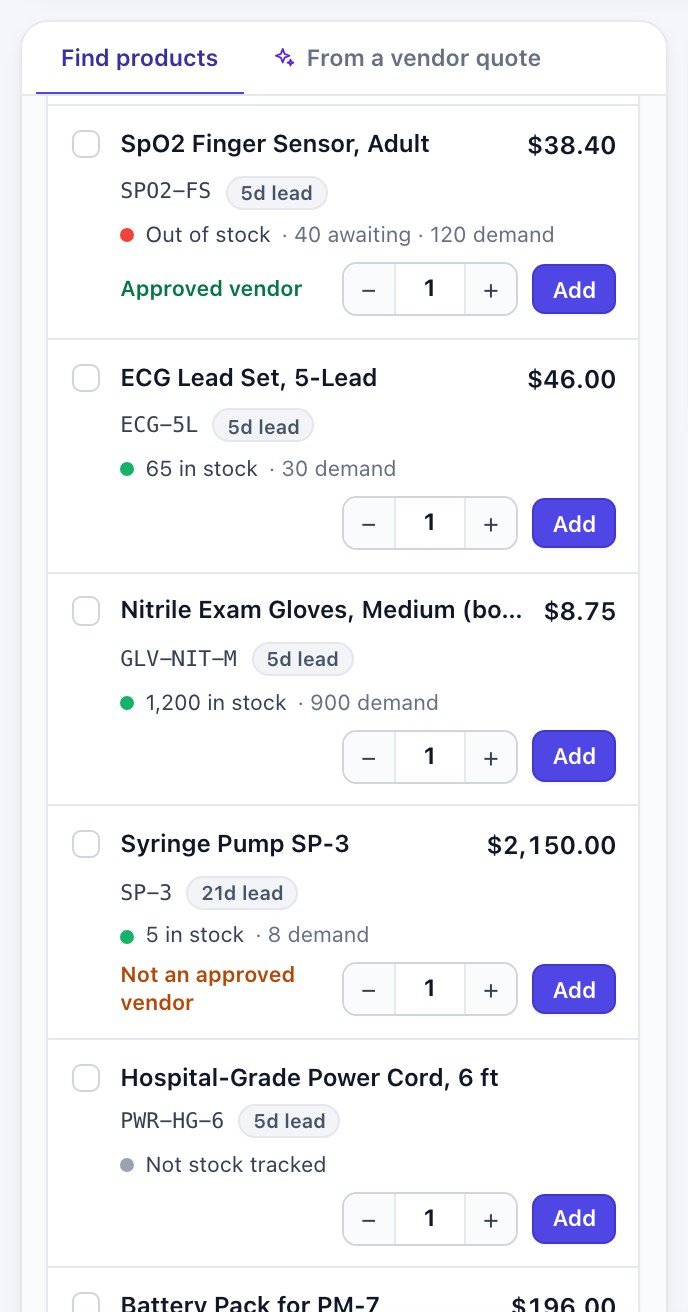
What the catalog tells you
- Price from the chosen vendor’s cost card. Products without a cost card show no price.
- Your own price you can also type the price yourself in the line’s Unit price once the product is added; the note under it then reads Manual (Chapter 7).
- Lead time for example 21d lead.
- Stock a green dot when there is stock in the receiving warehouse, red when there is none, with quantities awaiting receipt and in demand.
- Approved vendor green text when the vendor is approved for the product; amber Not an approved vendor when the product may only be bought from an approved vendor and this isn’t one.
Products you viewed recently are listed first, then the most recently created ones.
Add a custom item
To buy something that isn’t in the catalog a service, a one-off part select Custom item in the Items header. Name the item or service, then enter the quantity and unit price. Custom items are tagged Custom item, and the Custom filter shows them together.
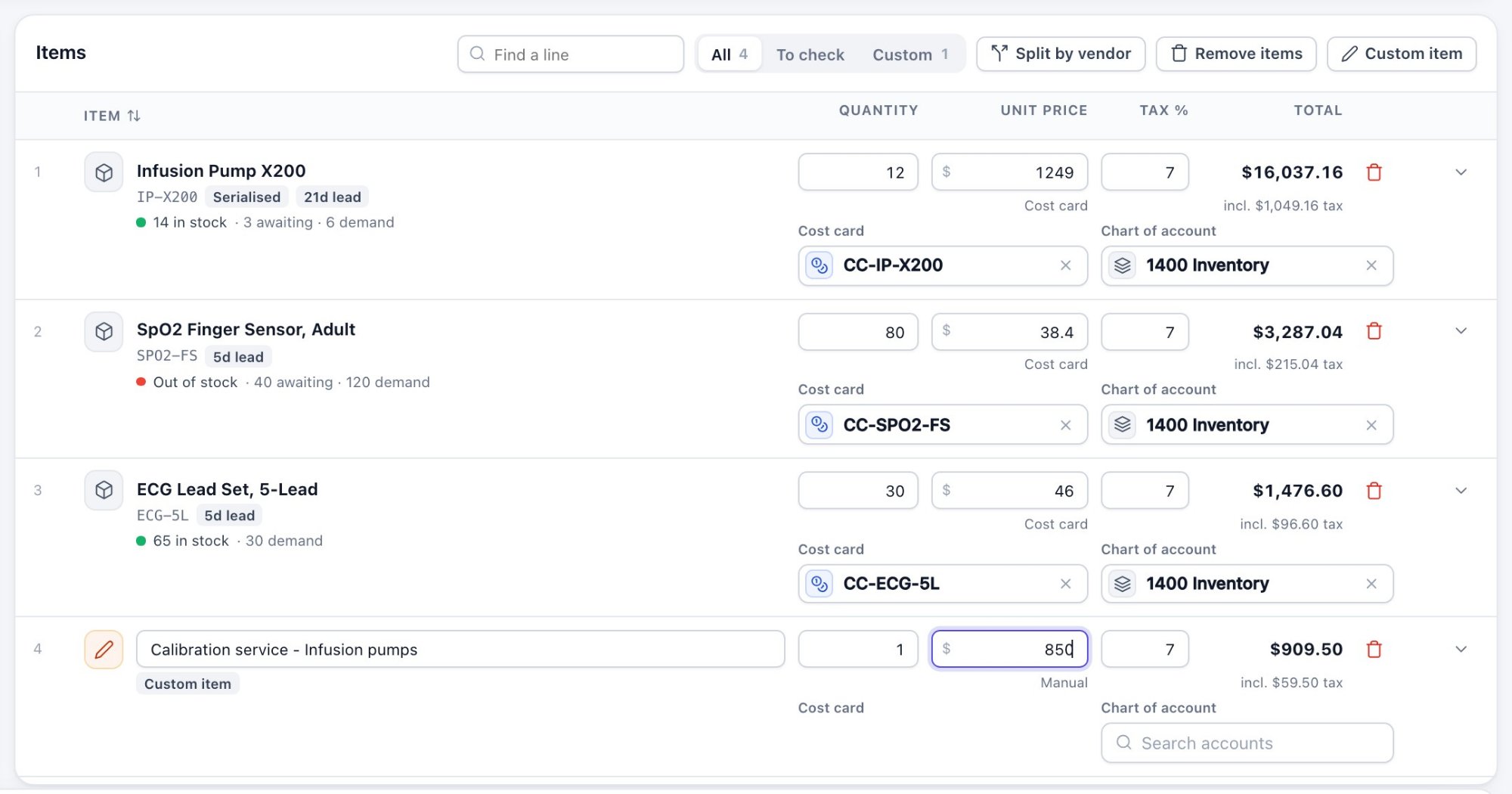
7. Lines, quantities and pricing
Every line shows what you are buying, how much, at what price, and anything that still needs your attention.
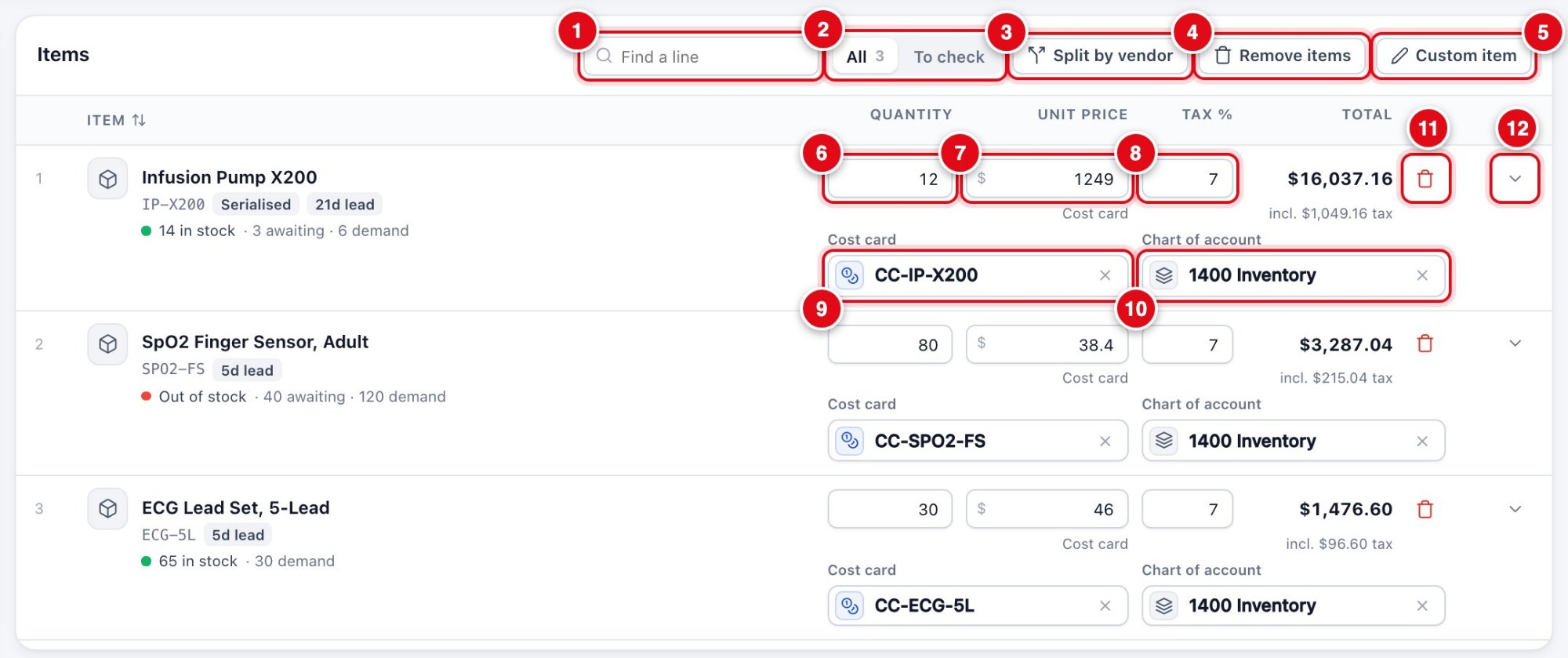
| # | Item | What it does |
|---|---|---|
| 1 | Find a line | Search the lines on a long purchase order. |
| 2 | Filters | All lines, lines To check, and Custom items, with counts. |
| 3 | Split by vendor | Choose a vendor for each item; each vendor gets its own purchase order tab (see Buy from several vendors below). |
| 4 | Remove items | Select several lines to remove at once. |
| 5 | Custom item | Add an item or service that isn’t in the catalog. |
| 6 | Quantity | How many to buy. |
| 7 | Unit price | The note under it says where the price came from: Cost card, Manual (typed by you) or the AI Purchase Planner. |
| 8 | Tax % | The sales tax rate for the line. The total under it includes the tax amount. |
| 9 | Cost card | The vendor cost card the price comes from. Choose another to reprice the line. |
| 10 | Chart of account | The account the purchase is booked to. |
| 11 | Remove line | Removes this line after you confirm. |
| 12 | Details | The chevron at the right end of the line opens the line’s details and purchase insights. |
Quantities and prices
- Type the Quantity and Unit price directly in the line. Totals update as you type.
- Prices come from the vendor’s cost card when there is one. Choose a different Cost card to reprice the line, or type a price yourself.
- Tax % starts with the rate for the vendor’s address and profile.
- Select a column title Item, Quantity, Unit price or Total to sort the lines.
- Each line shows the product’s name with its product code under it. Product names are links to the product record; saved lines link to their purchase order line.
Lines that need attention
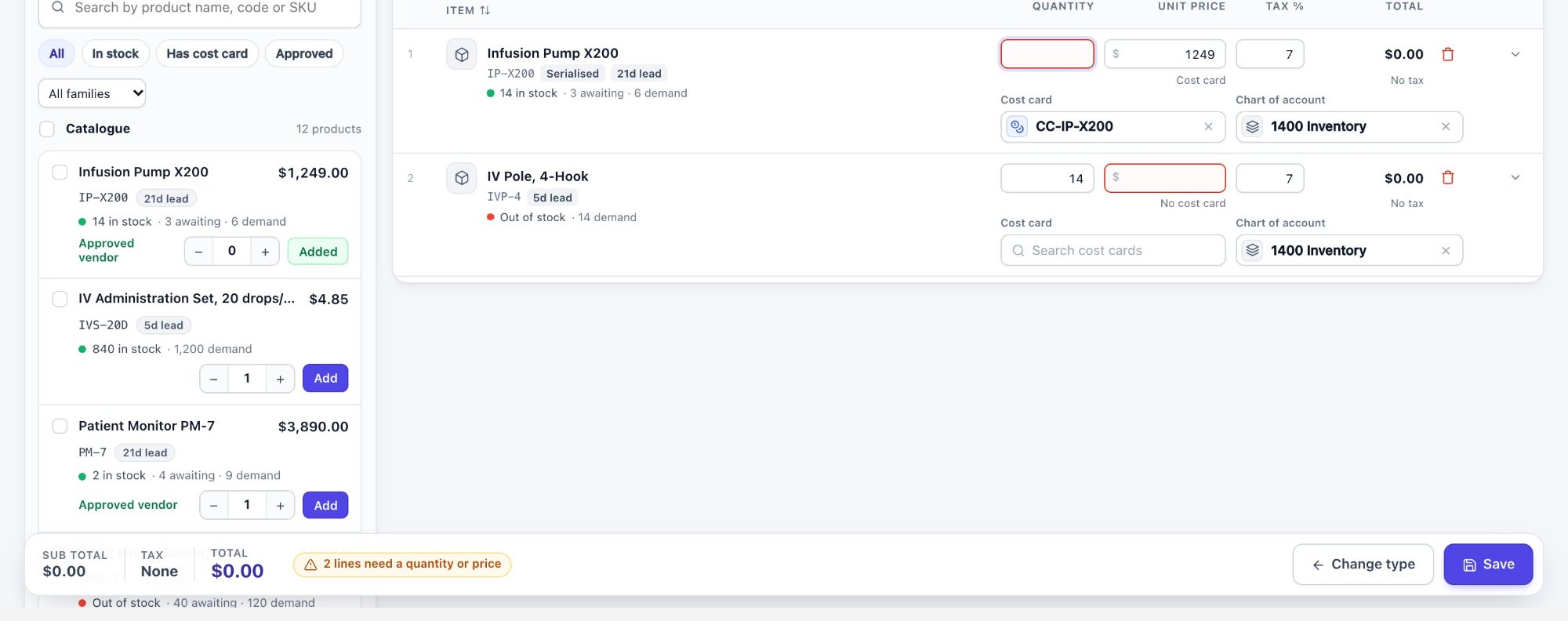
Axolt checks every line as you work. A field that needs attention is outlined: red for a missing name, quantity or price (or, on a return, more than was received) and amber for a price of zero. Hover over the field to see why. The To check filter shows only those lines, and the totals bar says how many lines still need a quantity or price.
Approved vendors
Some products may only be bought from an approved vendor. If such a product is on a purchase order whose vendor isn’t approved for it, the line turns light red and shows an alert icon hover over it to see the approved vendors. The purchase order can’t be saved until this is resolved.
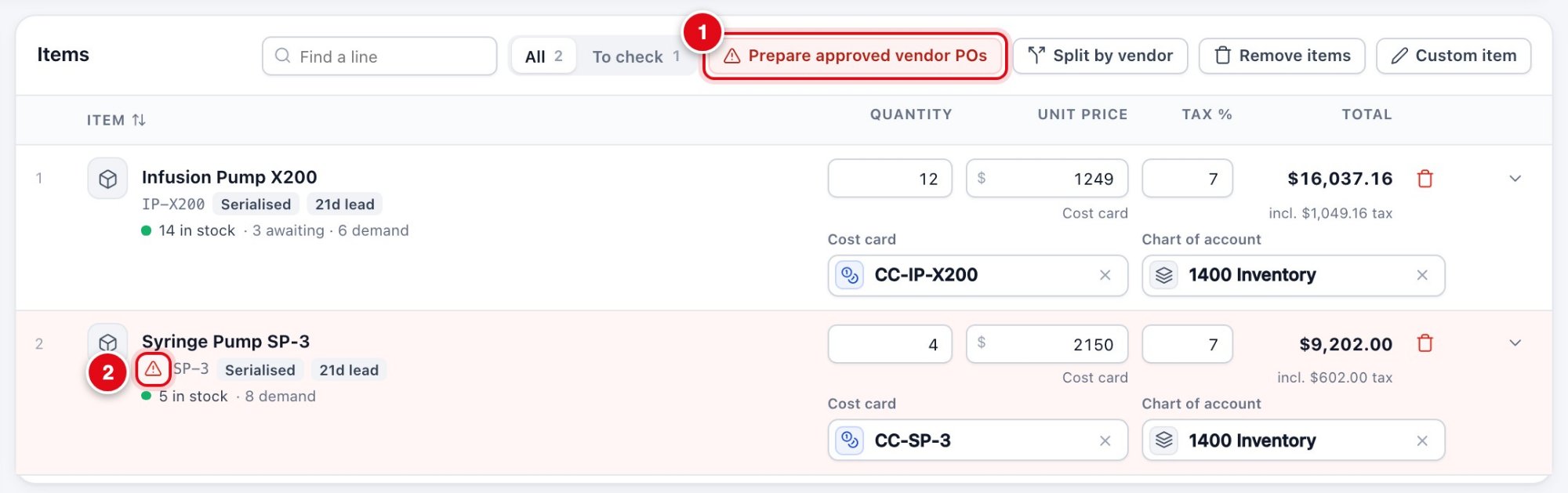
| # | Item | What it does |
|---|---|---|
| 1 | Prepare approved vendor POs | Moves those lines to new draft purchase orders for approved vendors as few as possible each in its own vendor tab. |
| 2 | Approved vendor alert | Hover to see why the line can’t be bought from this vendor and which vendors are approved. |
Buy from several vendors
When some items are better bought from another vendor, split the purchase order: choose a vendor for each item, and each vendor gets its own purchase order tab.
Select Split by vendor in the Items header. The popup lists the items on this purchase order or only the ones you ticked under Remove items each starting with this purchase order’s vendor.
Choose the vendor for an item in its Vendor column. The item is priced for that vendor at once: the vendor’s cost card, the card’s price and the sales tax of the vendor’s address. A price you typed yourself stays.
To use the same vendor for the rows below or above, drag the small square at the corner of the vendor field down or up as in a spreadsheet and release. With the keyboard, select the square, use the up and down arrows, then press Enter.
Change a quantity, unit price or tax rate if you need to. To leave an item out, remove it from the list with its red trash icon; it stays on this purchase order.
Check On apply, which shows where each vendor’s items go, and select Apply.
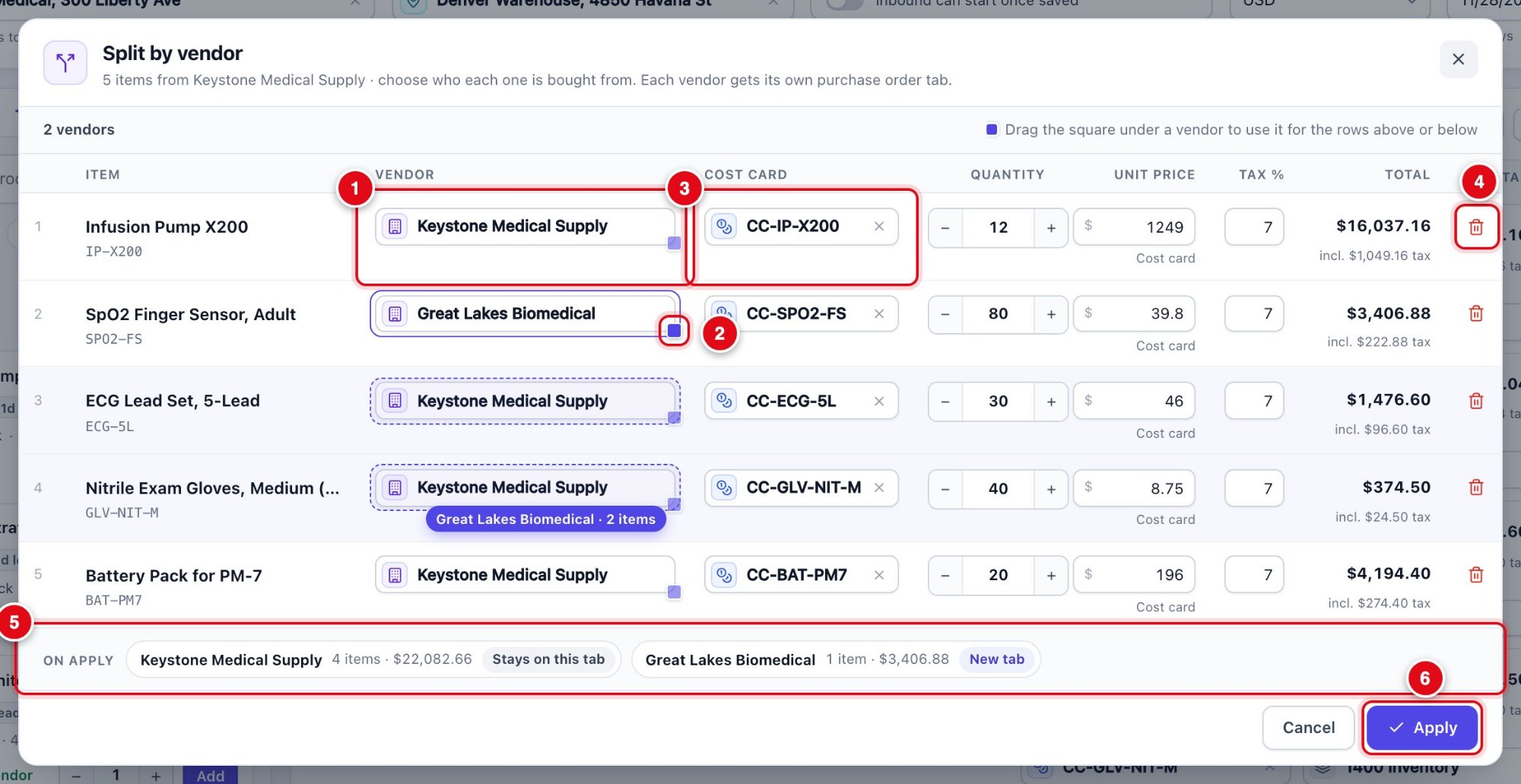
| # | Item | What it does |
|---|---|---|
| 1 | Vendor | Who the item is bought from. It starts with this purchase order’s vendor. |
| 2 | Fill handle | Drag it down or up to use the same vendor for those rows. |
| 3 | Cost card | The vendor’s cost card for the item. Choose another of the vendor’s cards to reprice the item. |
| 4 | Remove | Leaves the item out of the split; it stays on this purchase order. |
| 5 | On apply | Where each vendor’s items go: this tab, the vendor’s open tab, or a new tab. |
| 6 | Apply | Moves the items. Available once every item has a vendor. |
When you apply, the items for this purchase order’s own vendor stay here. Items for a vendor that already has a tab that isn’t saved yet are added to that tab a product already on it gets the quantity added. Every other vendor gets a new tab right after this one. Nothing is saved until you save each tab.
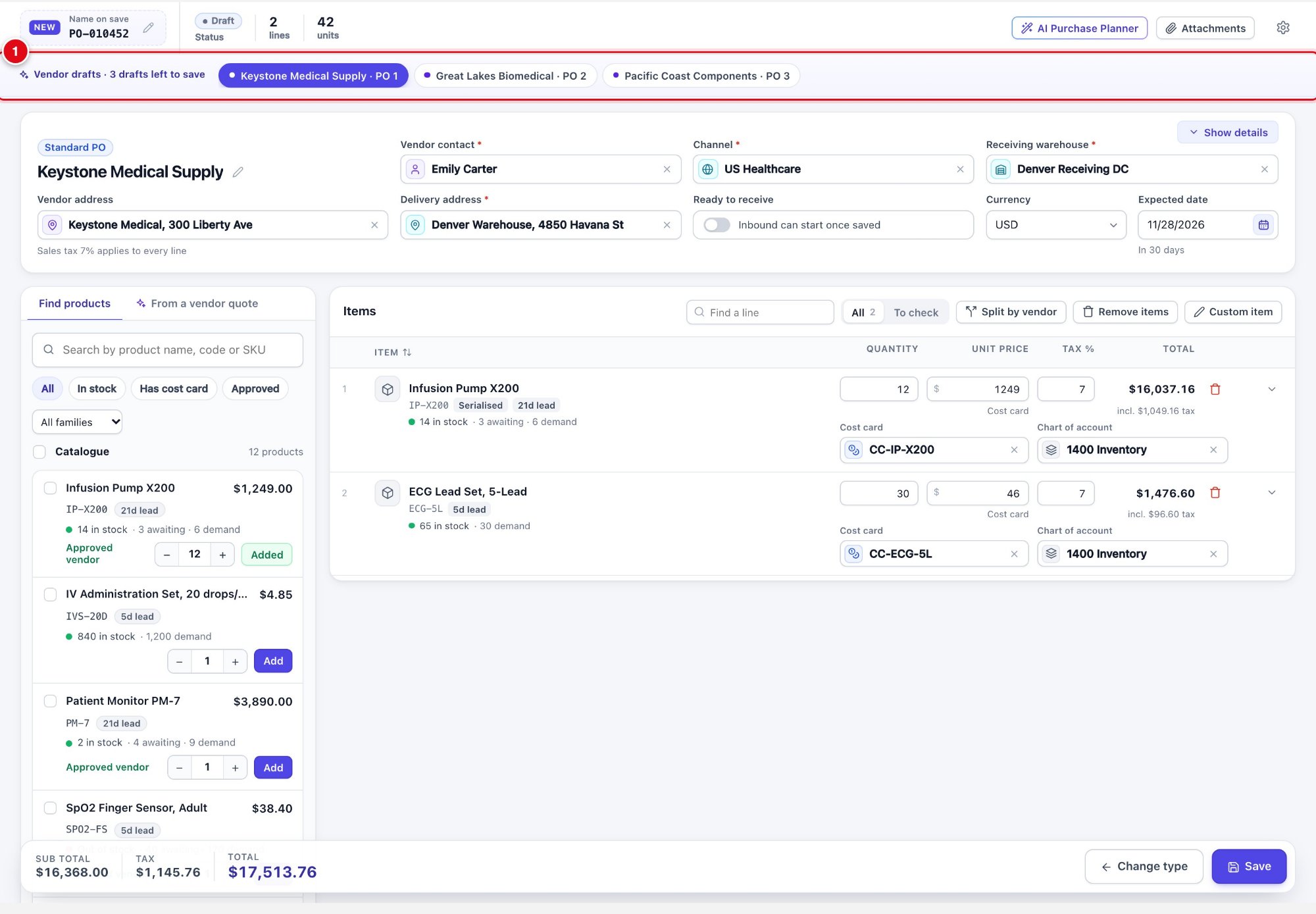
| # | Item | What it does |
|---|---|---|
| 1 | Vendor tabs | One draft purchase order per vendor. Switch between them, check each one and save it. |
Remove lines
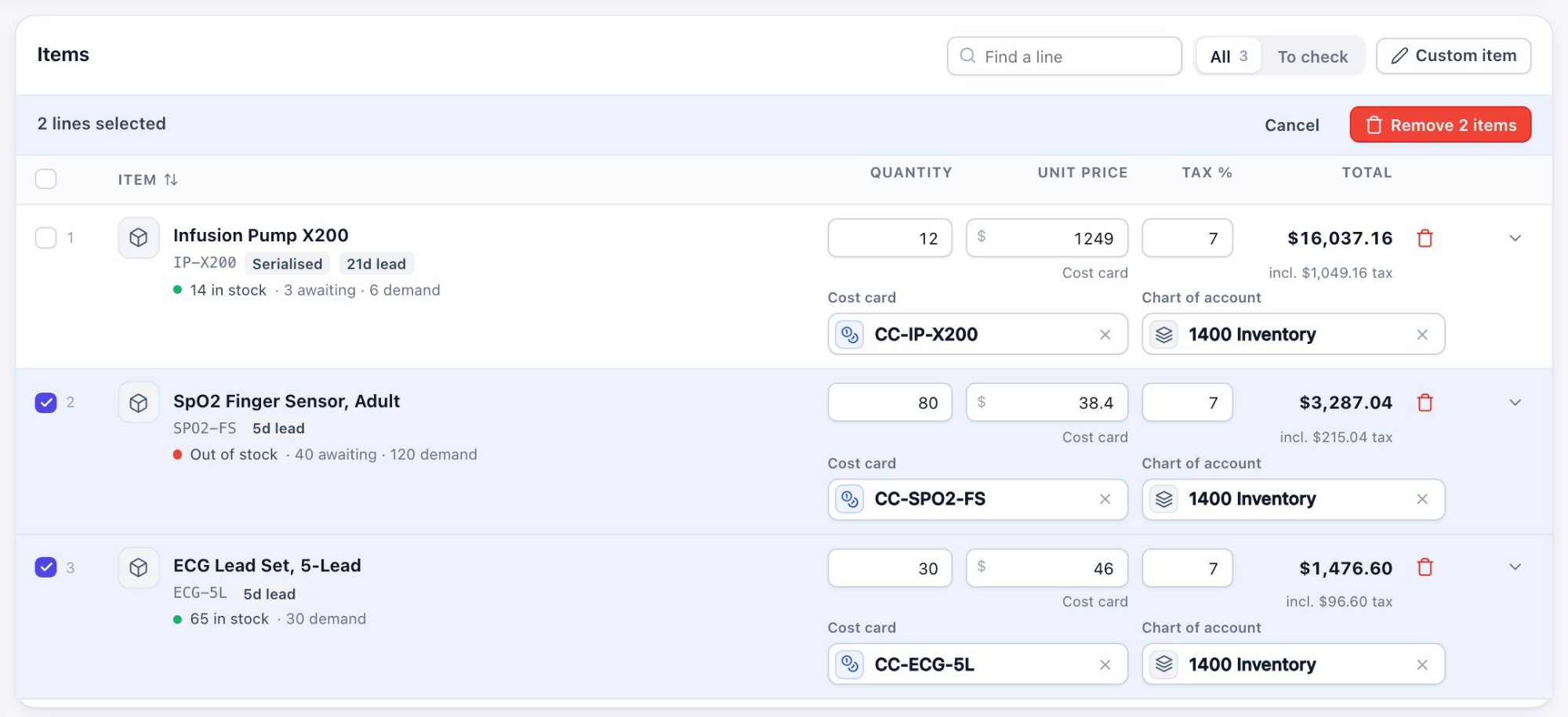
To remove one line, select its red trash icon and confirm with Remove item.
To remove several, select Remove items, tick the lines and select Remove N items in the bar that appears.
Check the list in the confirmation and select Remove N items or Keep them.
8. Line details and purchase insights
Open a line to complete its details and see whether the price, the vendor and the quantity are right.
Select the chevron at the right end of a line to open its drawer. Select the chevron again, or anywhere outside the drawer, to close it.
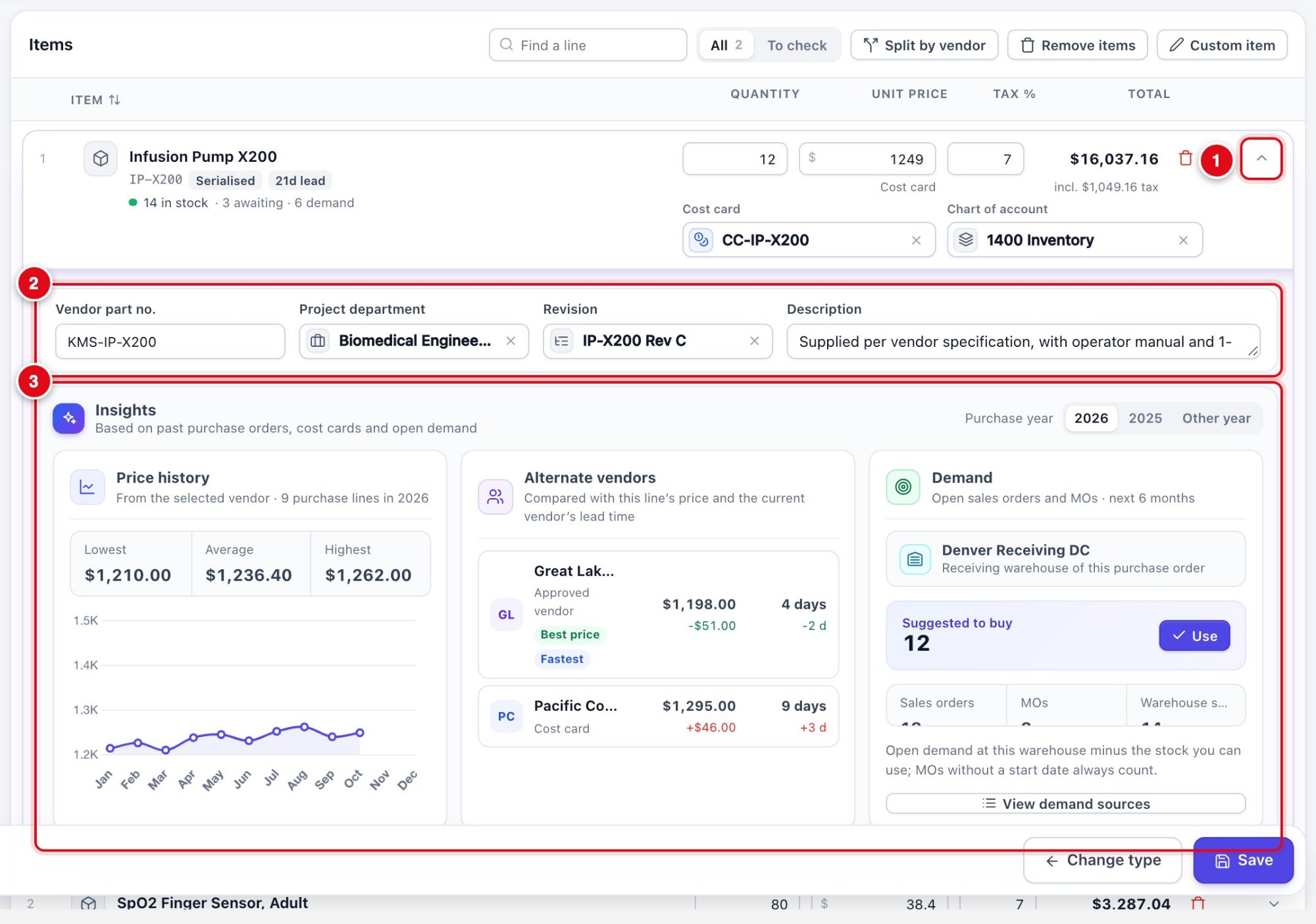
| # | Item | What it does |
|---|---|---|
| 1 | Details | The chevron opens and closes the line’s drawer. |
| 2 | Line details | Vendor part no., Project department, Revision and Description. |
| 3 | Purchase insights | Price history, alternate vendors and demand for the product. |
Line details
| Field | What it is for |
|---|---|
| Vendor part no. | The vendor’s own number for the product. |
| Description | What the vendor should supply. Filled in from the product’s vendor description. |
| Project department | The department the purchase is for. Shown when your administrator turns on departments and a project is chosen under Show details. |
| Revision | The product revision (bill of materials) to buy. Shown when your administrator turns on revisions. |
Purchase insights
Three cards help you check the line before you commit. Choose the Purchase year at the top right of the cards.
| Card | What it shows | How to use it |
|---|---|---|
| Price history | The lowest, average and highest price paid to this vendor for the product in the year, with a monthly trend. | Check that the unit price is in line with what you normally pay. |
| Alternate vendors | Other vendors for the product, with their price and lead time compared with this line. Best price and Fastest mark the leaders. | See whether another vendor would be cheaper or quicker. |
| Demand | Open sales orders and manufacturing orders for the product at your receiving warehouse, the stock you can use and the Suggested to buy quantity. | Select Use to set the line to the suggested quantity. View demand sources lists the orders behind it. |
9. Attachments
Keep the vendor’s quote, specifications or drawings with the purchase order.
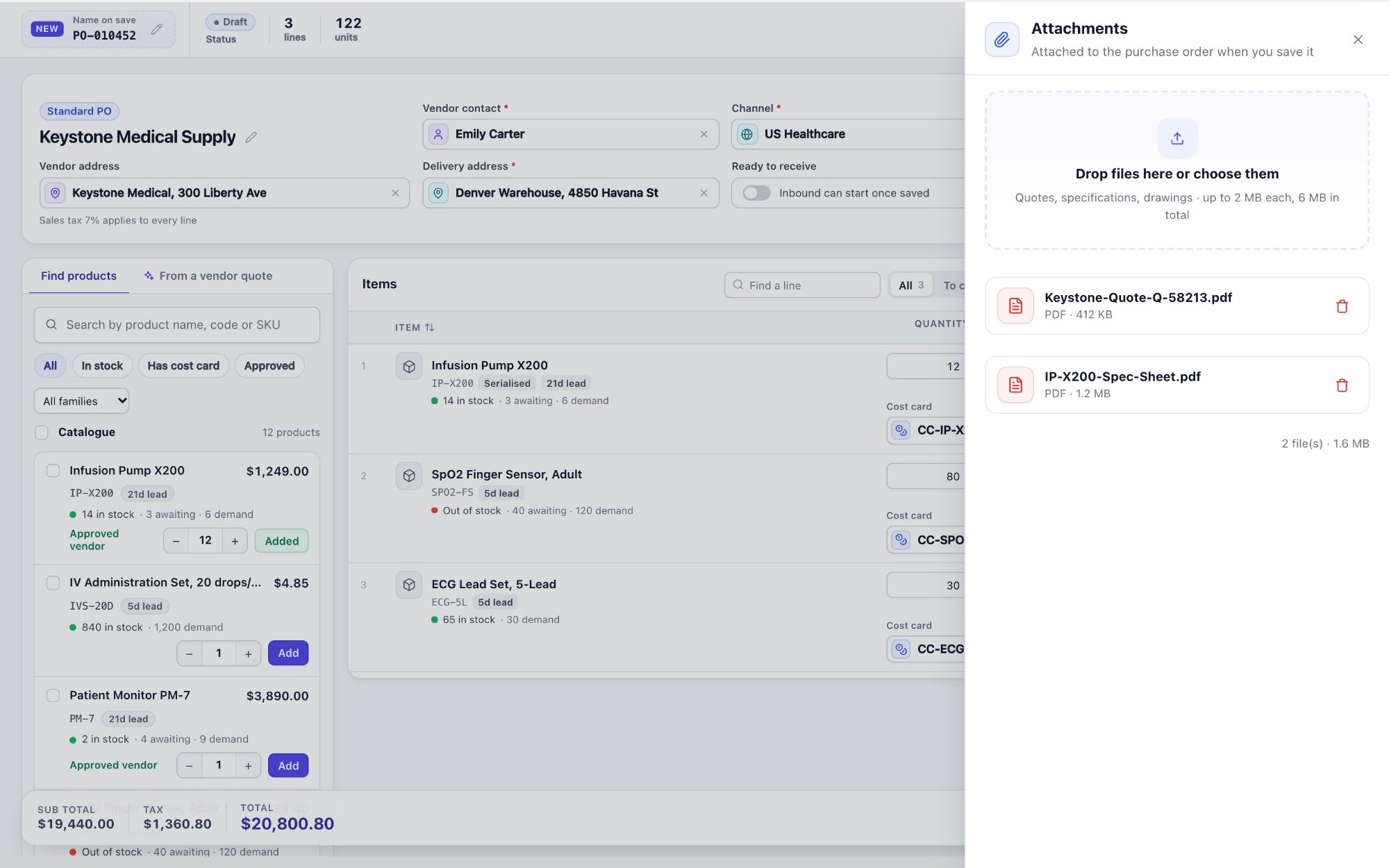
Select Attachments in the top bar.
Drop files onto the drawer, or select it to choose files. Each file can be up to 2 MB, and up to 6 MB in total.
Remove a file with its red trash icon. The files are attached to the purchase order when you save it.
10. Review and save
Check the totals, save, and send the purchase order to the vendor.
Check before you save
- The totals bar shows the Sub total, Tax and Total, and warns when lines still need a quantity or price.
- Use the To check filter to find lines that need attention.
- Required header fields are marked with a red asterisk. If one behind Show details is missing, the details open by themselves when you save.
Save
Select Save, or press ⌘ / Ctrl + S. Axolt checks the purchase order and tells you exactly what is missing, in the order it appears on screen. When the save succeeds:
- The new purchase order opens in a new browser tab, and a message confirms it for example PO-010452 created. Select Open in the message to open it again.
- The workspace stays on the saved purchase order, now marked EDIT with its number, so you can keep working on it.
- With Axo AI enabled, Review & send to vendor appears in the top bar.
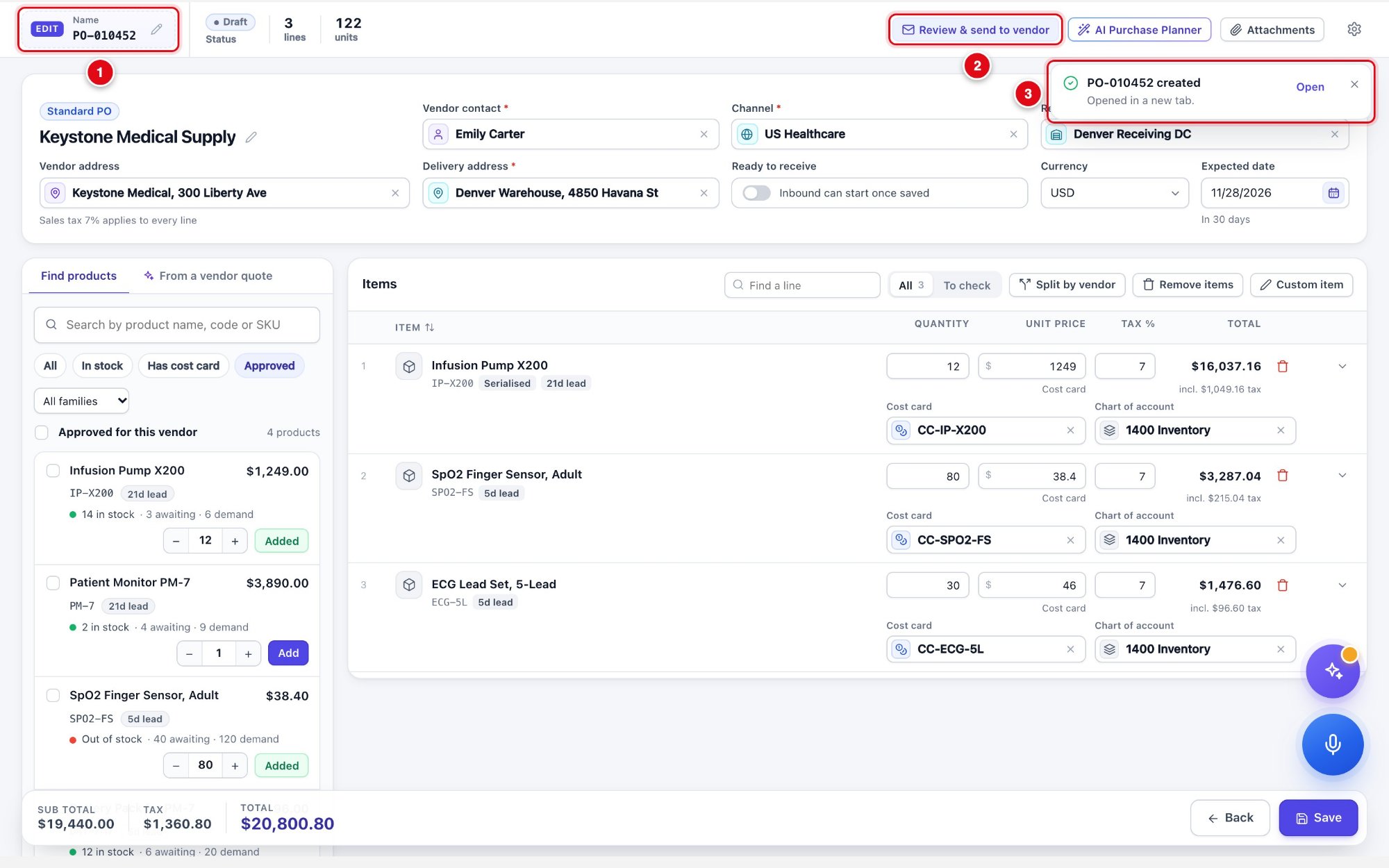
| # | Item | What it does |
|---|---|---|
| 1 | Saved name | The purchase order’s number. The tag reads EDIT for a saved purchase order. |
| 2 | Review & send to vendor | Opens the PO document and an email to the vendor. |
| 3 | Confirmation | The purchase order was created and opened in a new browser tab. |
If the name is already taken
If you chose your own name and another purchase order took it before you saved, Axolt asks what to do. Choose Use the next name in the series or Use my own name and type a different one, then save.
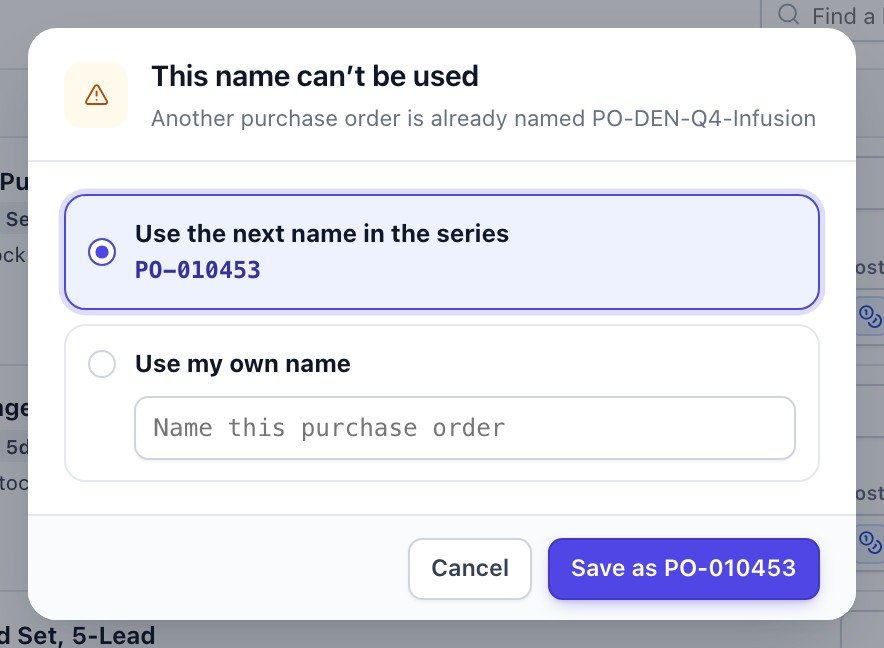
Use the next name in the series saves the purchase order with the next free number, shown under the option. Use my own name lets you type another name. The button at the bottom always says which name will be used.
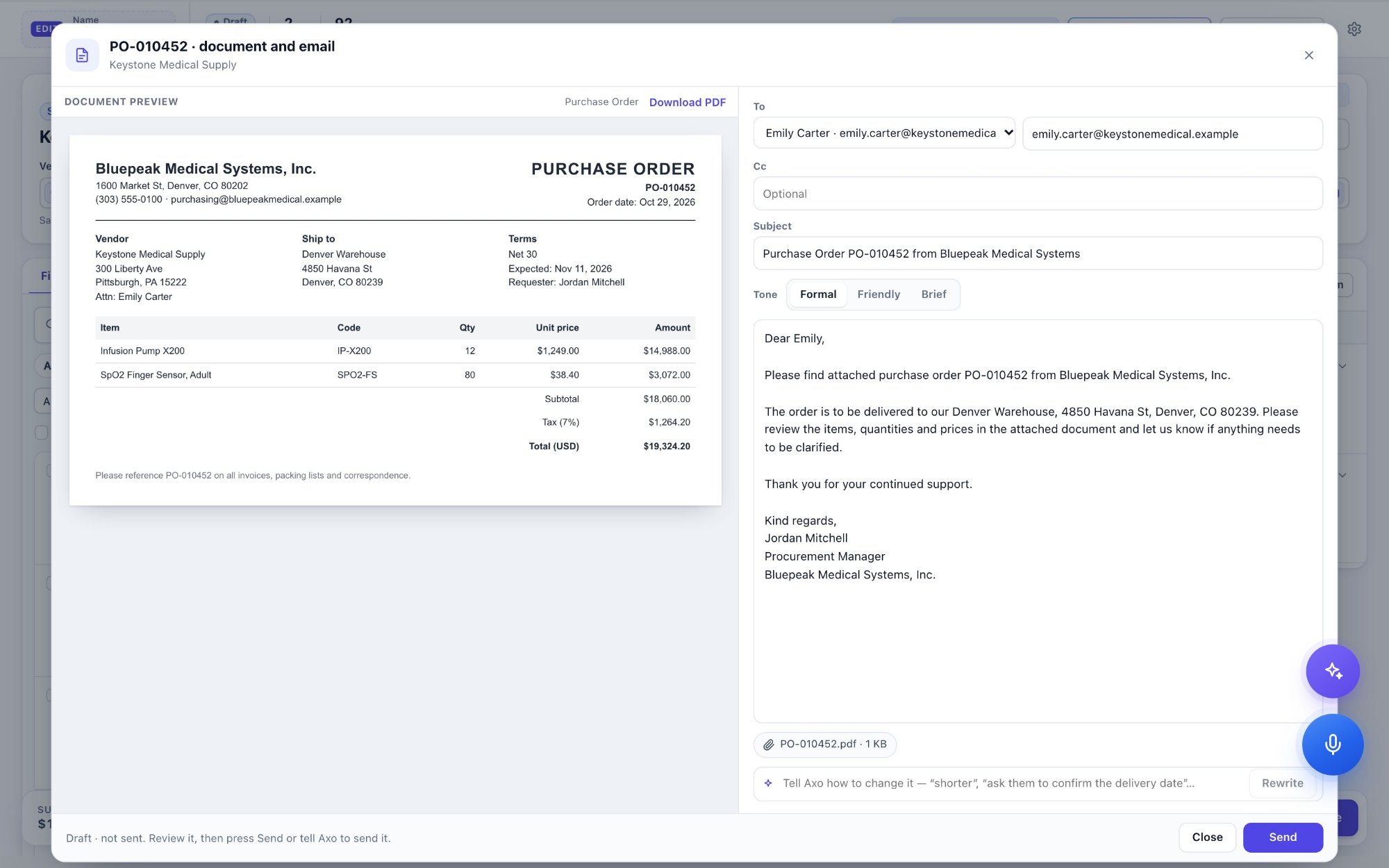
Send the purchase order to the vendor
When Axo AI is enabled, you can email a saved purchase order to the vendor without leaving the screen.
Select Review & send to vendor in the top bar.
Check the document preview on the left. Select Download PDF if you want a copy.
Check the email on the right: the recipient (To), Cc, Subject, the Tone (Formal, Friendly or Brief) and the message. The PO document is attached.
Select Send. To change the wording, edit it directly or tell Axo how to change it in the box under the message and select Rewrite.
Leaving without saving
Change type (or Back) and your browser’s back button work the same way. If the purchase order has unsaved changes, Axolt asks before anything is lost: select Keep working to stay, or confirm to discard the draft.
11. Drop ship purchase orders
The vendor ships straight to your customer, so there is no receiving warehouse and no stock movement.
On the start page, select Drop ship purchase order.
Choose the Customer / manufacturer and, optionally, one of their orders under Customer order.
Select Continue, then choose the vendor.
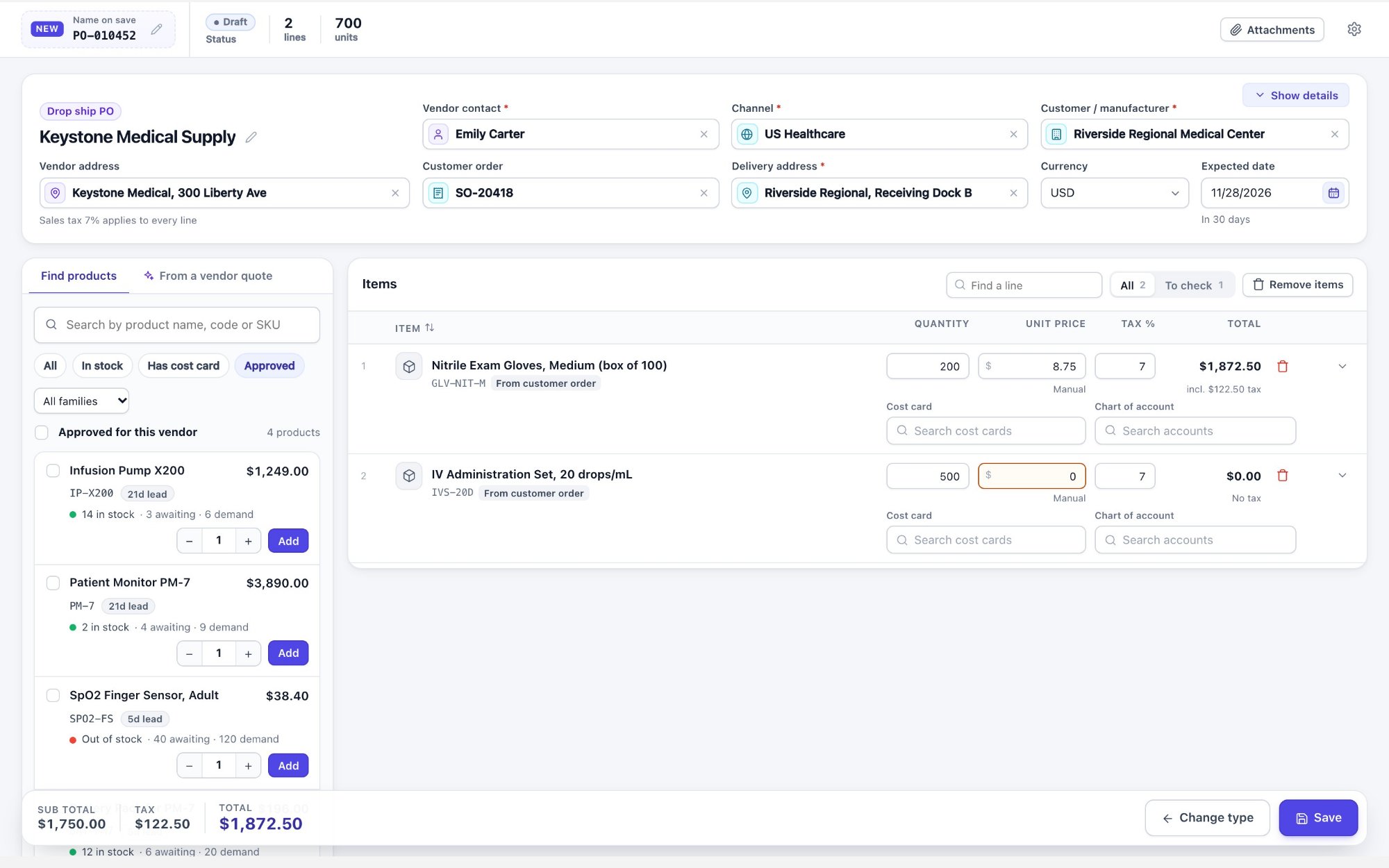
- The header shows the Customer / manufacturer and Customer order instead of a receiving warehouse.
- The Delivery address is the customer’s shipping address.
- Lines brought in from the customer’s order are tagged From customer order. Add, change or remove lines as on any purchase order the second line above still needs a price, so its price is outlined.
12. Returns to vendor
Send received goods back for credit or replacement, against the purchase order they were received on.
On the start page, select Return to vendor (RTV).
Choose the received purchase order filter by warehouse or vendor, or search by number and select Continue.
Set the Return qty for each line and remove the lines you are not returning.
Turn on Ready to pick / pack, beside the delivery address, when the goods can be picked, then Save.
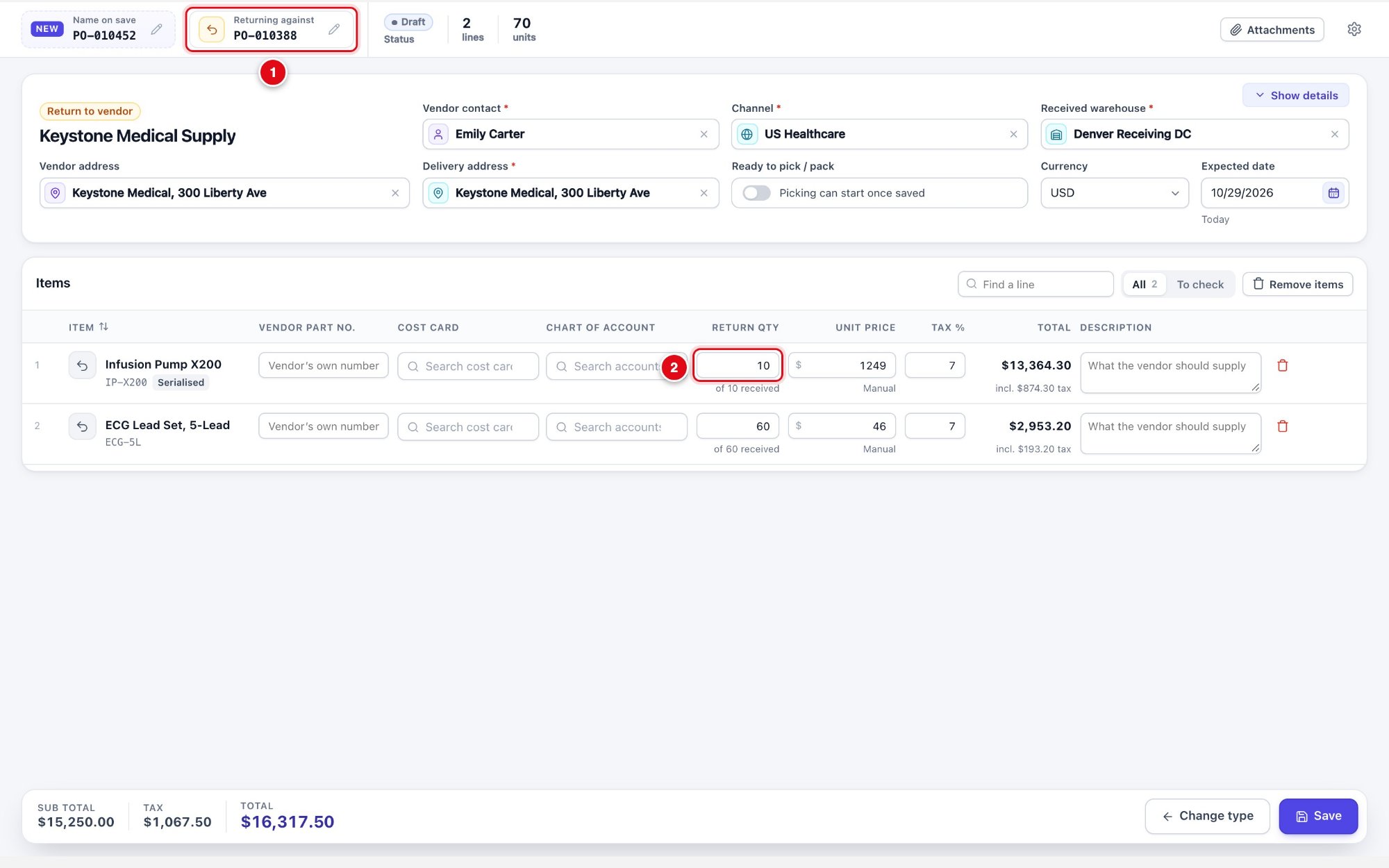
| # | Item | What it does |
|---|---|---|
| 1 | Returning against | The received purchase order this return is for. Select the pencil to switch to another one; Axolt asks first if you have unsaved changes. |
| 2 | Return qty | How many to return. The note under it shows how many were received you can’t return more. |
- The vendor is the received purchase order’s vendor and can’t be changed.
- The Delivery address is the vendor’s address.
- On wide screens the vendor part number and description sit in the line itself.
- A saved return shows Returned against the received purchase order.
13. Other ways to start, settings and shortcuts
Start from a copy of a purchase order, choose your settings, and work faster with the keyboard.
Copy a purchase order
On the start page, under Copy a purchase order, select one of the recent purchase orders or search for one by name. The workspace opens with the same vendor and items, priced at today’s cost-card prices. Change anything you need, then save it as a new purchase order.
Settings
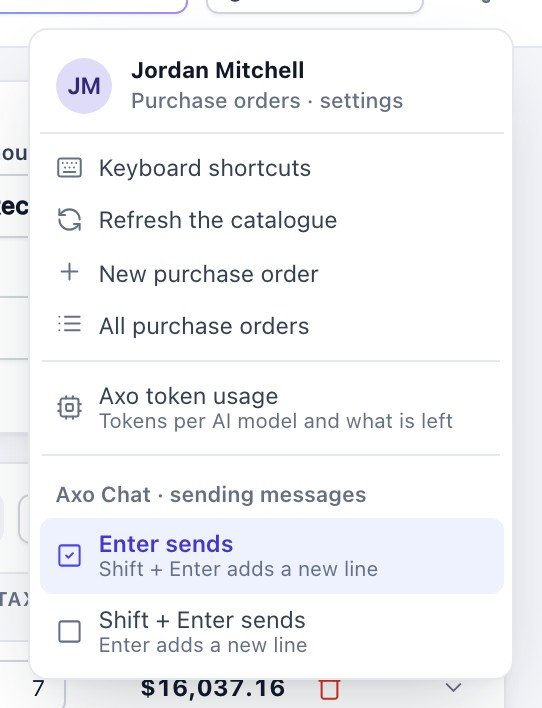
Select the gear at the top right.
| Item | What it does |
|---|---|
| Keyboard shortcuts | Lists the shortcuts below. |
| Refresh the catalogue | Reloads products, stock and prices. |
| New purchase order | Starts again from the start page. |
| All purchase orders | Opens the Purchase Orders list. |
| Axo token usage | AI usage per model and what is left. |
| Axo Chat · sending messages | Choose whether Enter or Shift + Enter sends a message in Axo Chat. |
Keyboard shortcuts
| Keys | Action |
|---|---|
| 1, 2, 3 | Choose the purchase order type (start page) |
| Enter | Continue with the chosen type (start page) |
| ⌘ / Ctrl + S | Save the purchase order |
| ⌘ / Ctrl + J | Open or close Axo Chat |
| Esc | Close menus and popups |
Part 3 · Intelligent purchasing with Axo
Plan from demand, compare vendors, create purchase orders and email them in your own words, typed or spoken.
14. Meet Axo
Axo is Axolt’s purchasing assistant. It knows your demand, stock, open purchase orders, vendors and prices and it works on the screen alongside you.
What Axo can do
| Ask Axo to… | For example |
|---|---|
| Plan from demand | “Plan my purchases from sales order demand” · “Plan MO raw materials” |
| Buy specific products | “I have products to buy” · “Buy 40 SpO2 sensors and 10 battery packs” |
| Compare vendors | “Is there a better vendor?” · “Which vendor should I use?” |
| Prepare several vendor POs | “Keep the first two with Keystone and use your recommendation for the rest” |
| Create the purchase orders | “Create the purchase orders” always after you confirm |
| Email the PO to the vendor | “Email the PO to the vendor” · “Make it friendlier” · “Send it” |
| Check an order | “What needs attention before saving?” · “Is the expected date realistic?” |
| Look things up | “How has Keystone Medical Supply delivered for us?” · “Show me the latest purchase orders” |
| Read a supplier quote | Attach a PDF, PNG or JPEG in Axo Chat or Axo Voice |
Open Axo
- Axo Chat select the violet sparkle button at the bottom right, or press ⌘ / Ctrl + J. An orange dot on the button means Axo has noticed something worth your attention.
- Axo Voice select the blue microphone button below it.
- Ask Axo on the start page, select a suggestion or type a question in the Ask Axo card.
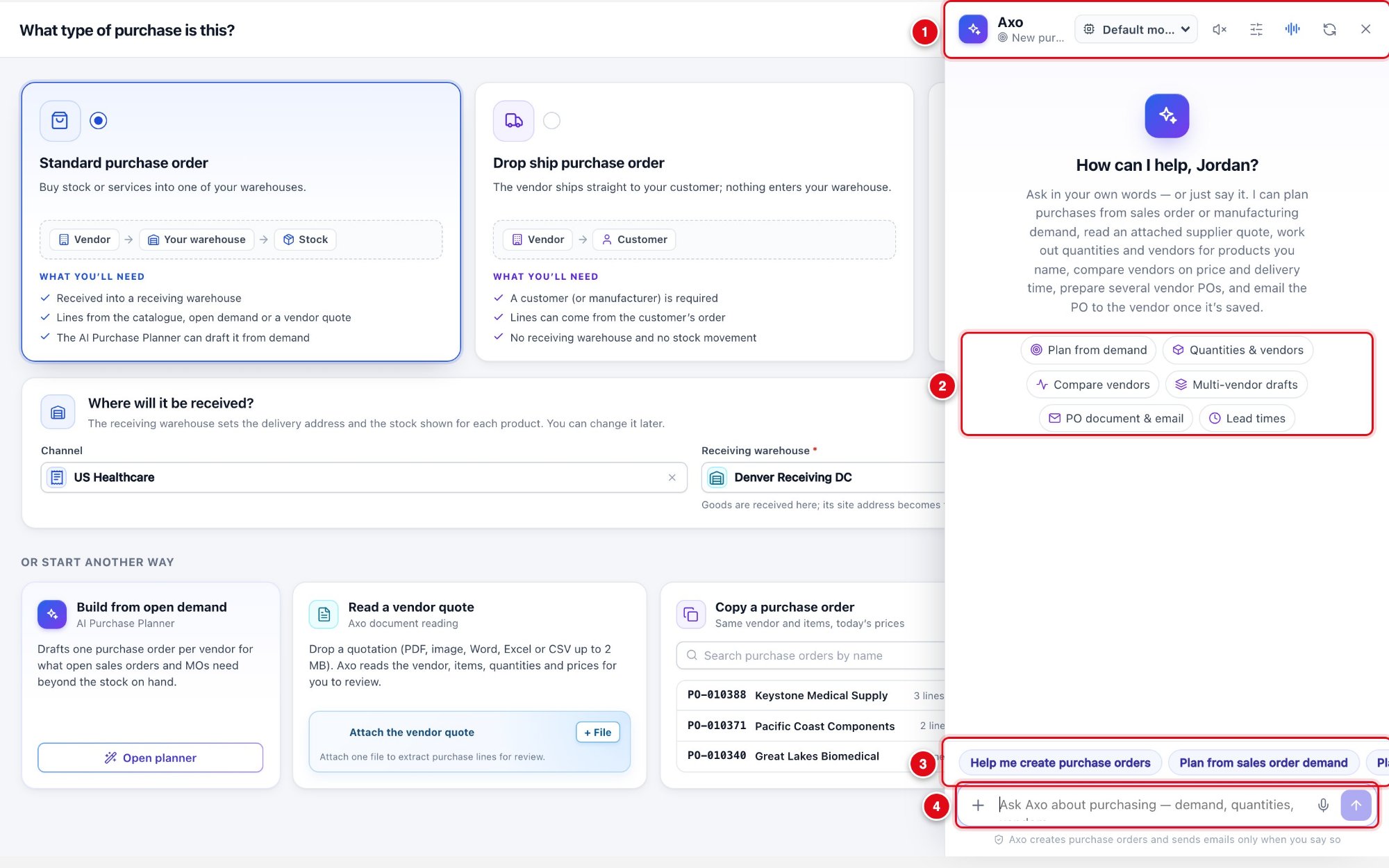
| # | Item | What it does |
|---|---|---|
| 1 | Chat header | The AI model, speak replies on or off, voice and speaking speed, switch to Axo Voice, new chat, and close. |
| 2 | What Axo can do | Plan from demand, quantities and vendors, compare vendors, multi-vendor drafts, PO document and email, lead times. |
| 3 | Suggestions | One-select shortcuts that change with what you are doing. |
| 4 | Message box | Type in your own words. + attaches a quote; the microphone lets you dictate instead of typing. |
How Axo works and what stays in your control
| Suggestions run instantly | Suggestion chips and Axo’s own buttons run straight away the reply is marked Instant · no AI call. |
| Your own words are understood | Anything you type or say is understood by AI and turned into the right action even with typos or misheard words. Axo shows what it understood. |
| Numbers come from Salesforce | Demand, stock, open purchase orders, prices and delivery times always come from your Salesforce data, never from the AI model. |
| Nothing happens without you | Applying a plan only fills the screen with drafts. Axo creates purchase orders and sends emails only after you confirm by button, in writing or by voice. |
| Prices are estimates | Planning prices come from cost cards and recent purchase orders. They are not vendor quotes. |
| Records are yours | Purchase orders Axo creates are saved through the screen’s normal save, as you. |
15. Plan purchases from demand
Axo looks at open sales orders and manufacturing orders, takes off the stock you have and what is already on order, and prepares draft purchase orders per vendor.
Start a plan
Open Axo Chat and select Help me create purchase orders or type “Help me create purchase orders”.
Choose what to plan from: Sales order demand, MO raw materials, Specific products or A vendor quote. Or ask directly: “Plan from demand”.
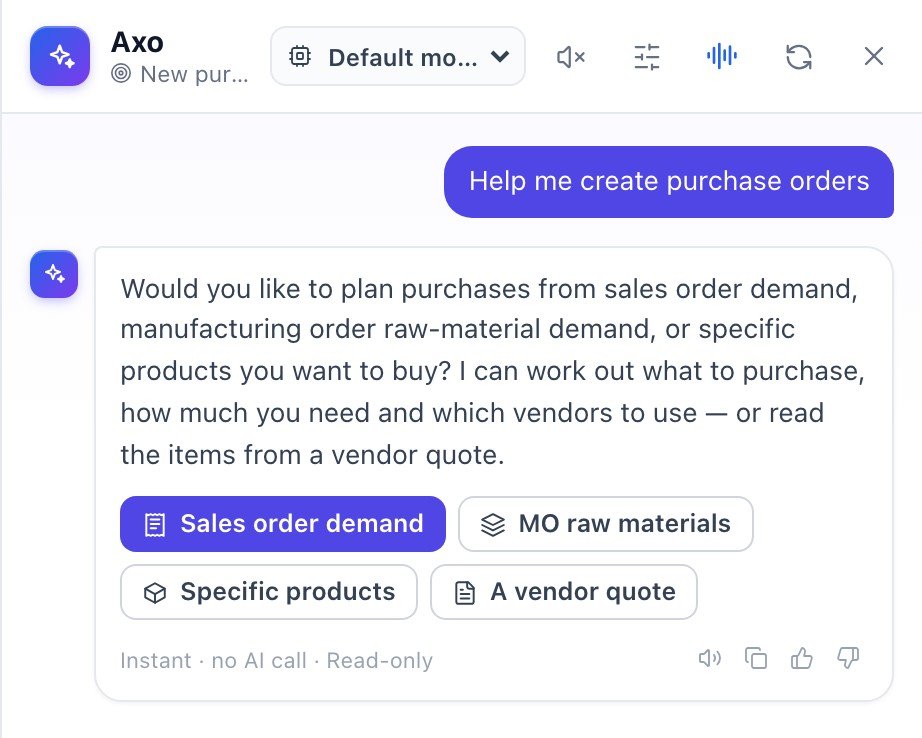
| You | Help me create purchase orders |
| Axo | Would you like to plan purchases from sales order demand, manufacturing order raw-material demand, or specific products you want to buy? I can work out what to purchase, how much you need and which vendors to use or read the items from a vendor quote. Sales order demand · MO raw materials · Specific products · A vendor quote |
Review the plan
Axo prepares the plan and opens it on screen, next to the conversation.
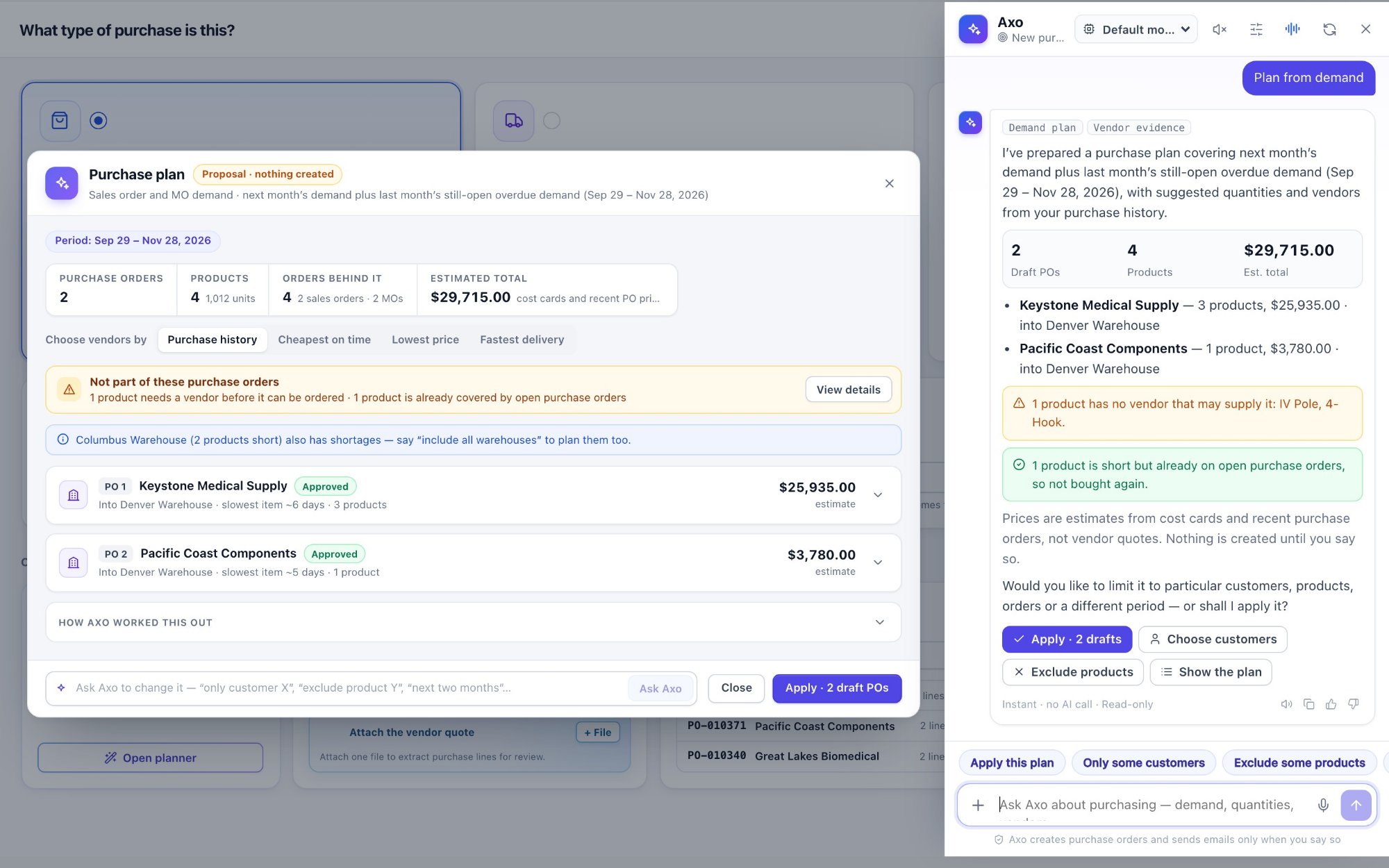
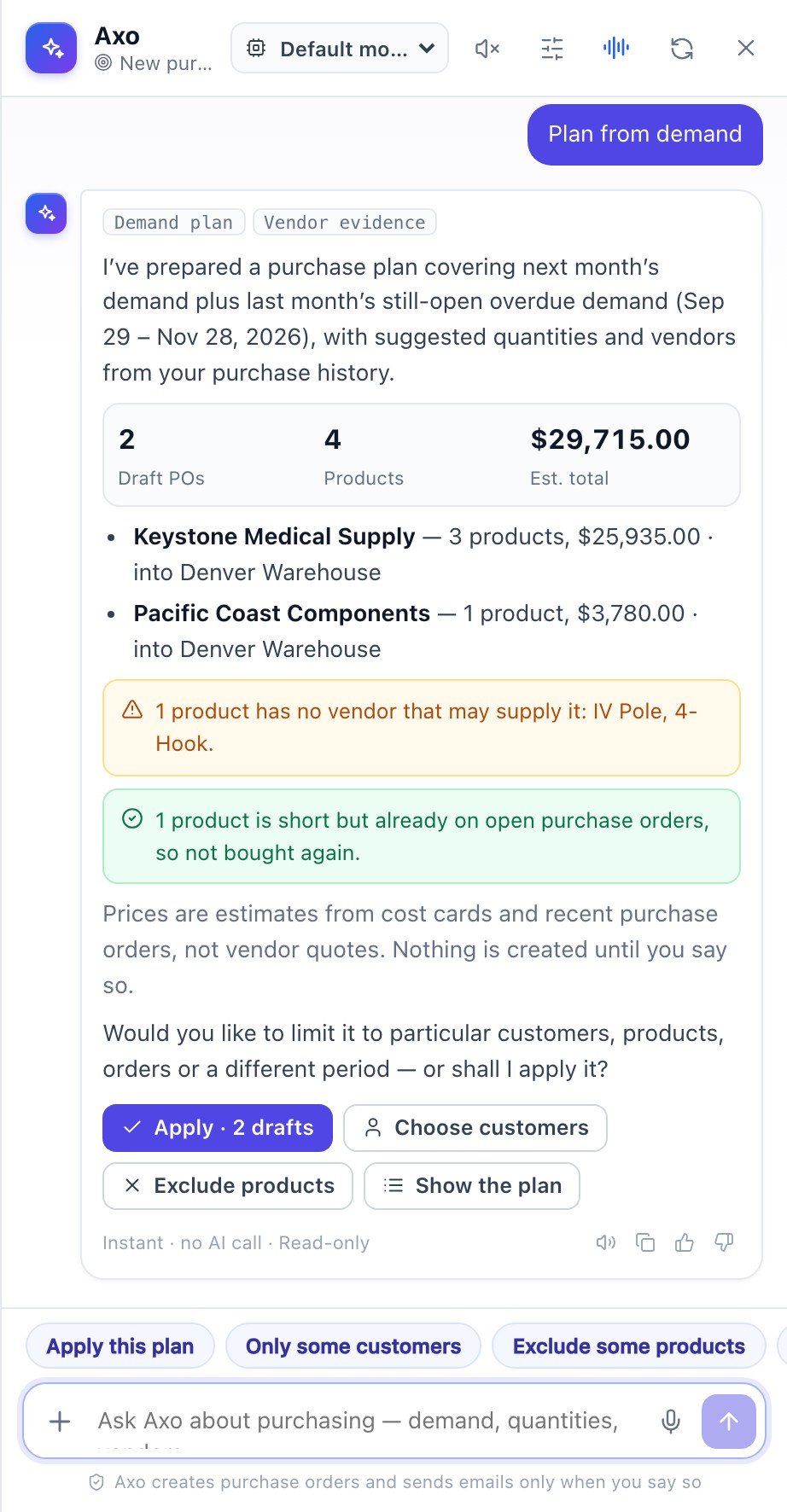
| You | Plan from demand |
| Axo | I’ve prepared a purchase plan covering next month’s demand plus last month’s still-open overdue demand (Sep 29 – Nov 28, 2026), with suggested quantities and vendors from your purchase history. 2 Draft POs · 4 Products · $29,715.00 Est. total • Keystone Medical Supply 3 products, $25,935.00 · into Denver Warehouse • Pacific Coast Components 1 product, $3,780.00 · into Denver Warehouse 1 product has no vendor that may supply it: IV Pole, 4-Hook. 1 product is short but already on open purchase orders, so not bought again. Would you like to limit it to particular customers, products, orders or a different period or shall I apply it? |
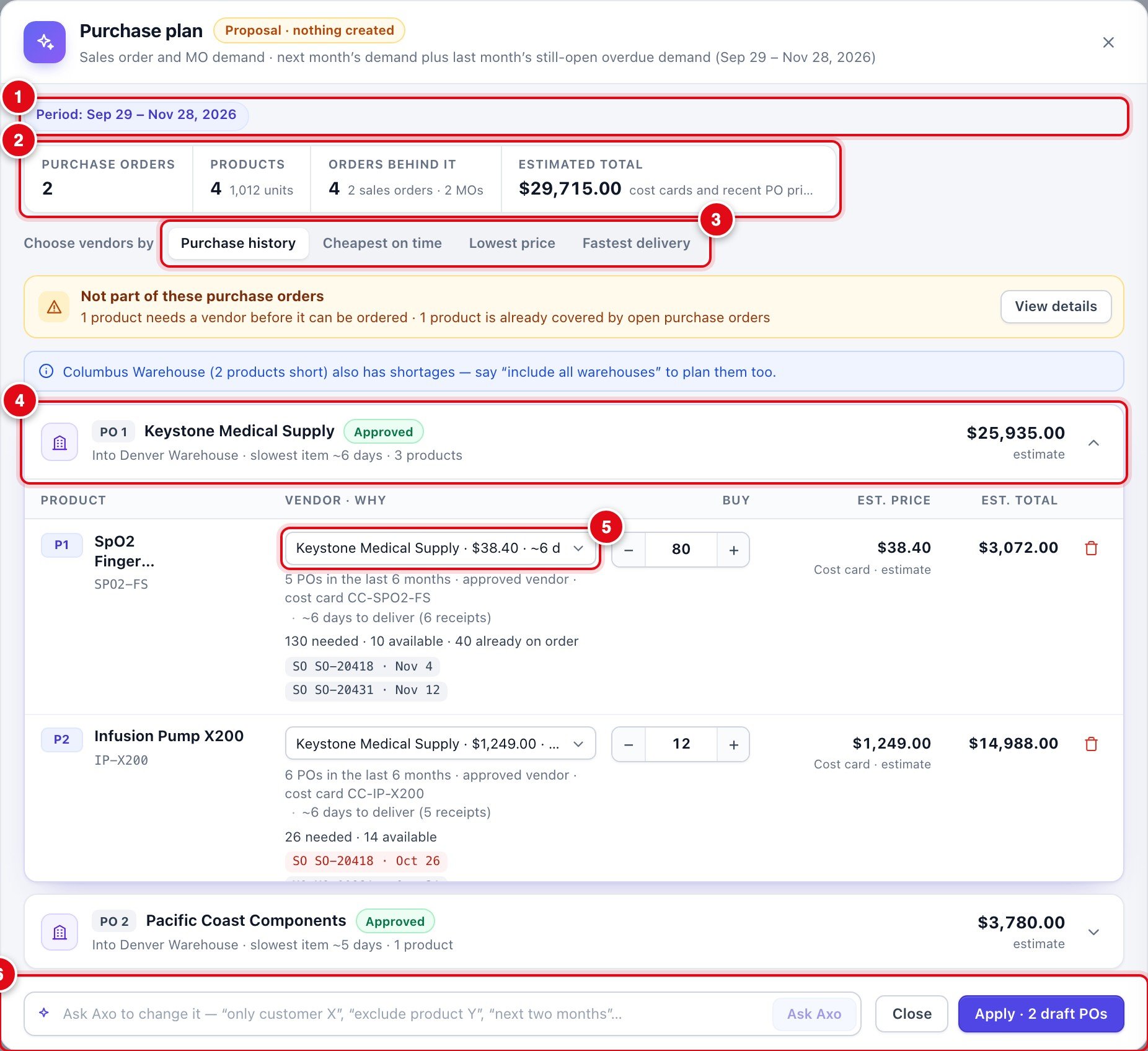
| # | Item | What it does |
|---|---|---|
| 1 | Filters | The demand period and any customers, products or orders the plan is limited to. |
| 2 | Summary | Purchase orders, products and units, the orders behind the plan, and the estimated total. |
| 3 | Choose vendors by | Purchase history, Cheapest on time, Lowest price or Fastest delivery. |
| 4 | Draft purchase order | One per vendor (PO 1, PO 2…): vendor, warehouse, slowest item and estimated total. Select it to open its lines. |
| 5 | Vendor for the line | Change the vendor for a product; each choice shows its price and delivery time. Under it, the evidence: recent POs, approval, cost card, delivery time, demand and the orders behind it. |
| 6 | Ask Axo and Apply | Type a change for Axo, close the plan, or apply it as draft purchase orders. |
How Axo works out what to buy
| Step | What Axo does |
|---|---|
| Demand | Open sales order lines expected, and manufacturing order raw-material lines starting, in the demand window by default next month, plus overdue demand from the last month that is still open. |
| Products | Only products that can be purchased are planned. |
| Stock | Available, pickable stock in the receiving warehouse less reserved, in quality check and minimum stock goes to the earliest need first, as in the AI Purchase Planner. |
| Already on order | Quantities on open purchase orders not yet received are taken off what to buy. Products fully covered this way are listed but not bought again. |
| Vendors | By purchase history unless you choose otherwise: the vendor you bought from recently, then approved vendors, cost cards and the last purchase. |
| Prices and delivery times | Prices from cost cards or recent purchase orders, in the purchase order’s currency. Delivery times are measured from when a purchase order was created to its first receipt. |
Select How Axo worked this out at the bottom of the plan to read these rules for the plan on screen.
16. Refine the plan and choose what to buy
Narrow the plan, widen it, or start from the products you already know you need. Axo updates the plan instead of starting over.
Change the plan in your own words
| Say or type | What changes |
|---|---|
| “Only include demand for Riverside Regional Medical Center” | Limits the plan to one customer’s demand. |
| “Exclude the IV poles” | Leaves a product out. |
| “Cover the next two months” | Widens the demand window. |
| “Only overdue demand” | Plans what is already late. |
| “Include all warehouses” | Plans every warehouse with shortages, not only the receiving warehouse. |
| “Ignore what’s already on order” | Stops taking open purchase orders off the quantities. |
| “Plan for SO-20418 only” | Limits the plan to particular orders. |
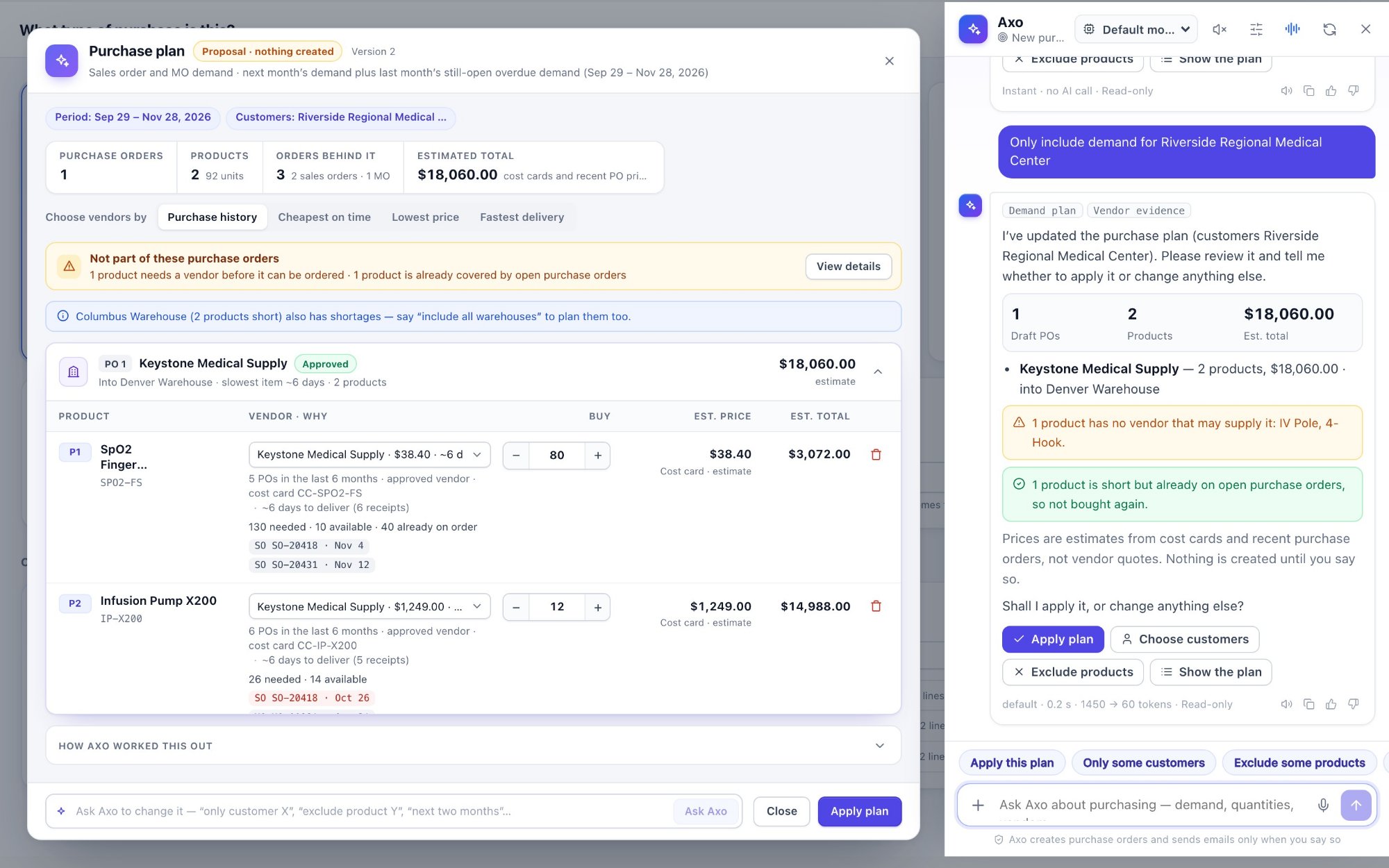
The conversation behind the screenshot above
| You | Only include demand for Riverside Regional Medical Center |
| Axo | I’ve updated the purchase plan (customers Riverside Regional Medical Center). Please review it and tell me whether to apply it or change anything else. 1 Draft PO · 2 Products · $18,060.00 Est. total • Keystone Medical Supply 2 products, $18,060.00 · into Denver Warehouse Shall I apply it, or change anything else? |
Choose customers, products or orders from a list
If you don’t know the exact names, select Choose customers or Exclude products in Axo’s reply or say “only some customers”. Axo opens a search with your recently viewed records. Tick the ones you want and select Done (or say “done”), and Axo rebuilds the plan.
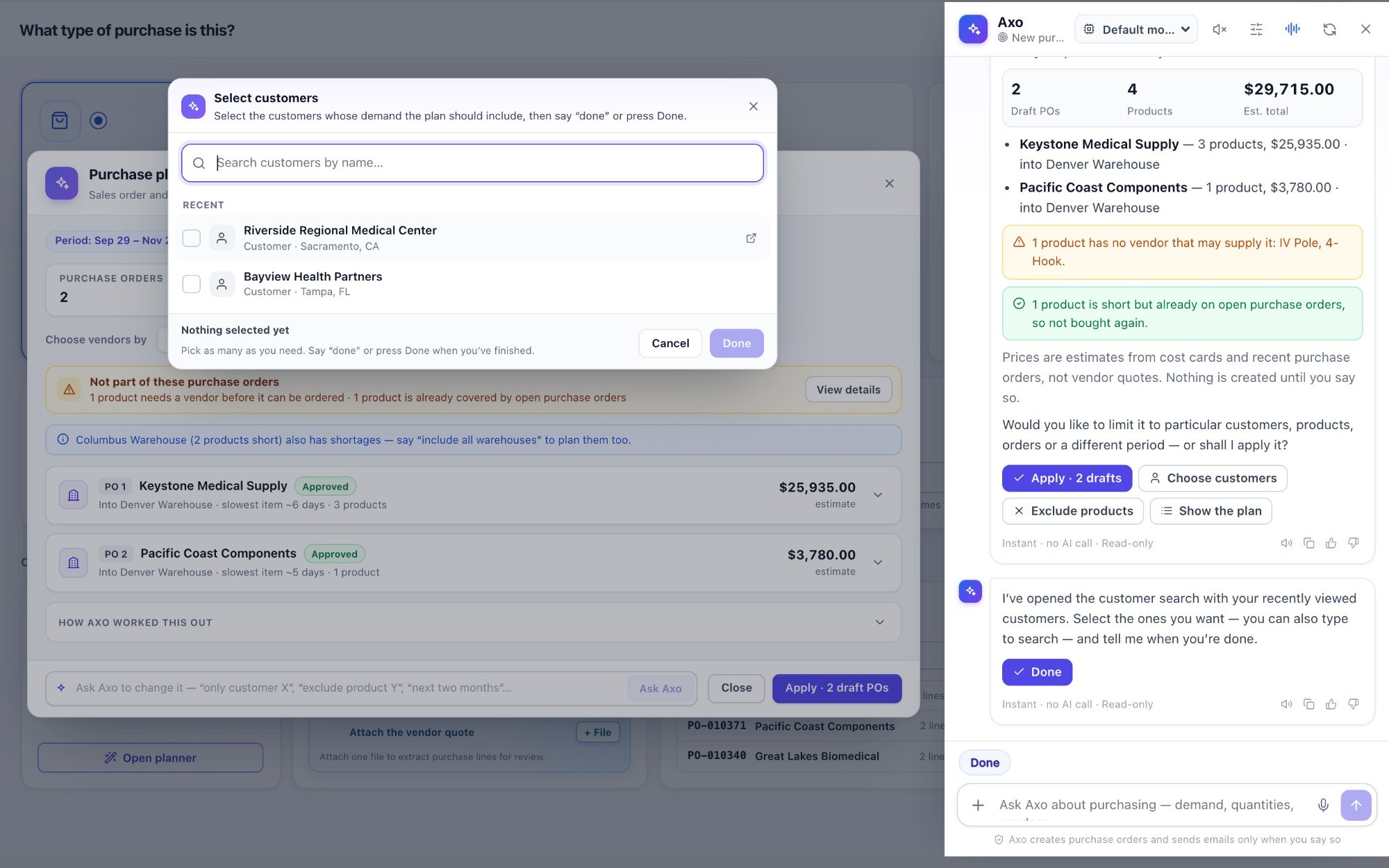
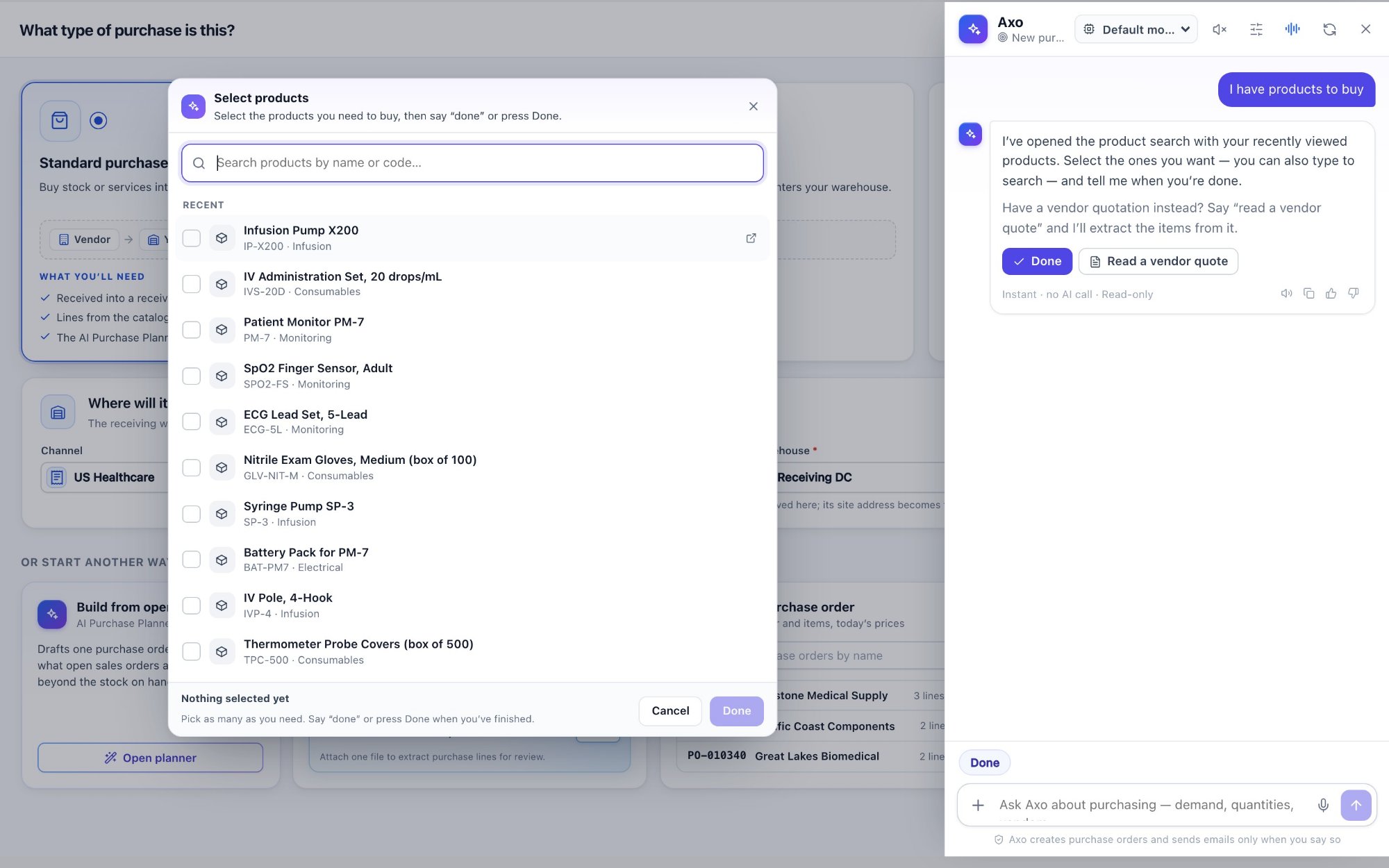
Buy specific products
When you already know what to buy, select I have products to buy (or say “I have some products I need to buy”). Choose the products in the search and say “done”. Axo works out the quantities from their demand, stock and open purchase orders and suggests vendors. You can also name them: “Buy 40 SpO2 sensors and 10 battery packs”.
17. Vendor recommendations and comparisons
See every vendor side by side price, real delivery time and the saving and decide product by product.
Compare vendors
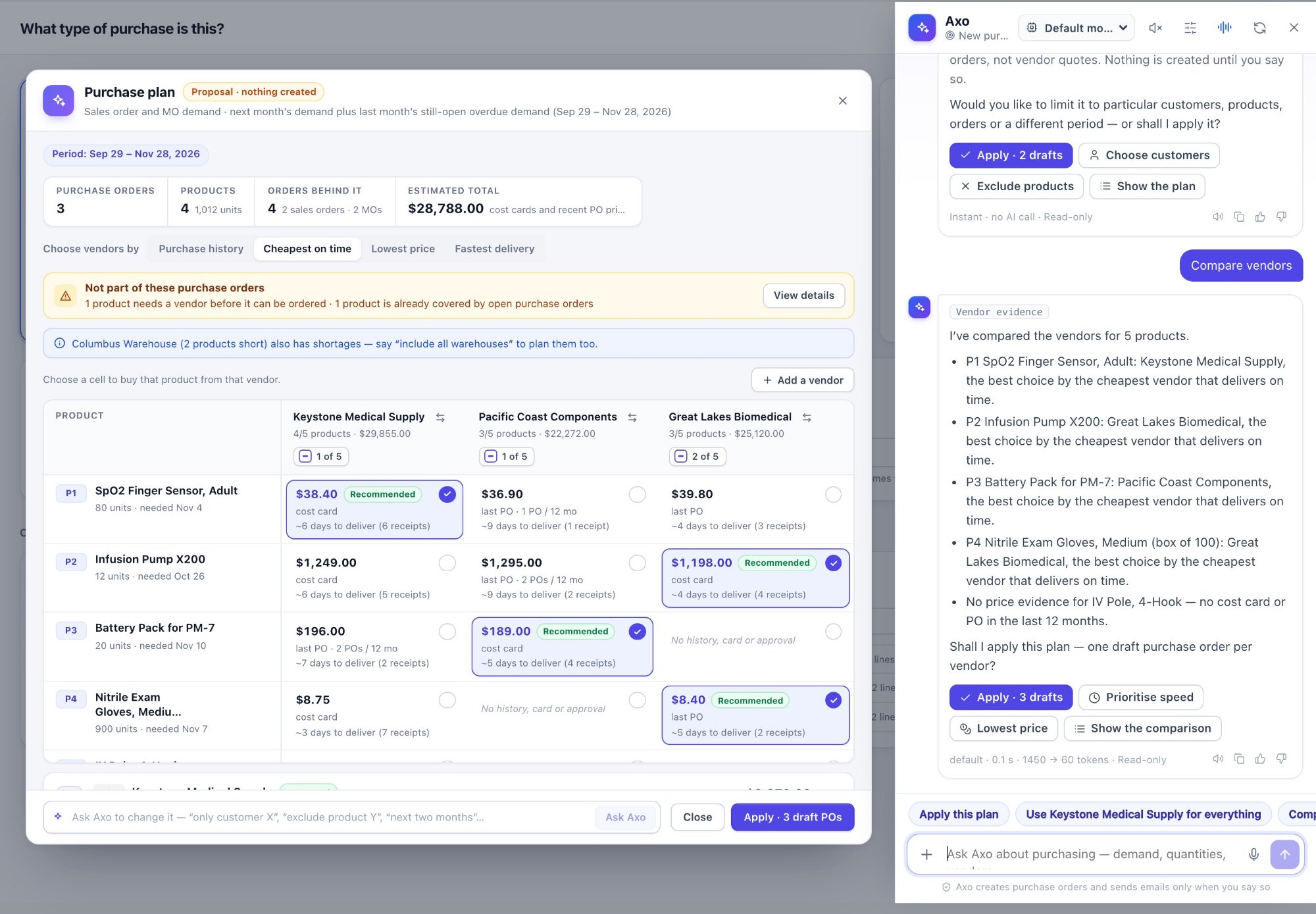
Ask “Compare vendors” with a plan open, or “Is there a better vendor?” on a purchase order. Axo opens the comparison: one row per product, one column per vendor, with the recommended vendor for each product highlighted.
Axo’s recommendation
| You | Compare vendors |
| Axo | I’ve compared the vendors for 5 products. • P1 SpO2 Finger Sensor, Adult: Keystone Medical Supply, the best choice by the cheapest vendor that delivers on time. • P2 Infusion Pump X200: Great Lakes Biomedical, the best choice by the cheapest vendor that delivers on time. • P3 Battery Pack for PM-7: Pacific Coast Components, the best choice by the cheapest vendor that delivers on time. • P4 Nitrile Exam Gloves, Medium (box of 100): Great Lakes Biomedical, the best choice by the cheapest vendor that delivers on time. No price evidence for IV Pole, 4-Hook no cost card or PO in the last 12 months. Shall I apply this plan one draft purchase order per vendor? |
Work with the comparison
- Select a cell to buy that product from that vendor also from a vendor with no purchase history yet. Each product has one chosen vendor: its cell is outlined, with a tick in the round marker.
- Use the box in a vendor’s column header to put all or none of the products with that vendor.
- Select ⇄ in a column header to compare a different vendor in its place, or Add a vendor to compare one more.
- Switch Choose vendors by to change the recommendation: Cheapest on time, Lowest price, Fastest delivery or Purchase history.
Ask for the vendors you want
| Say or type | What Axo does |
|---|---|
| “Prioritize delivery speed for everything” | Recommends the fastest vendor for every product. |
| “Speed for the first two, cheapest for the rest” | Applies a different priority to different lines. |
| “Keep the first three with the current vendor and use your recommendation for the rest” | Splits the purchase across vendors. |
| “Buy items 1, 2 and 5 of PO 1 from Great Lakes Biomedical” | Moves those lines to that vendor’s draft. |
| “Compare with Lone Star Electrical Supply too” | Adds a vendor to the comparison. |
| “Don’t use Pacific Coast Components” | Moves its products to their next-best vendor. |
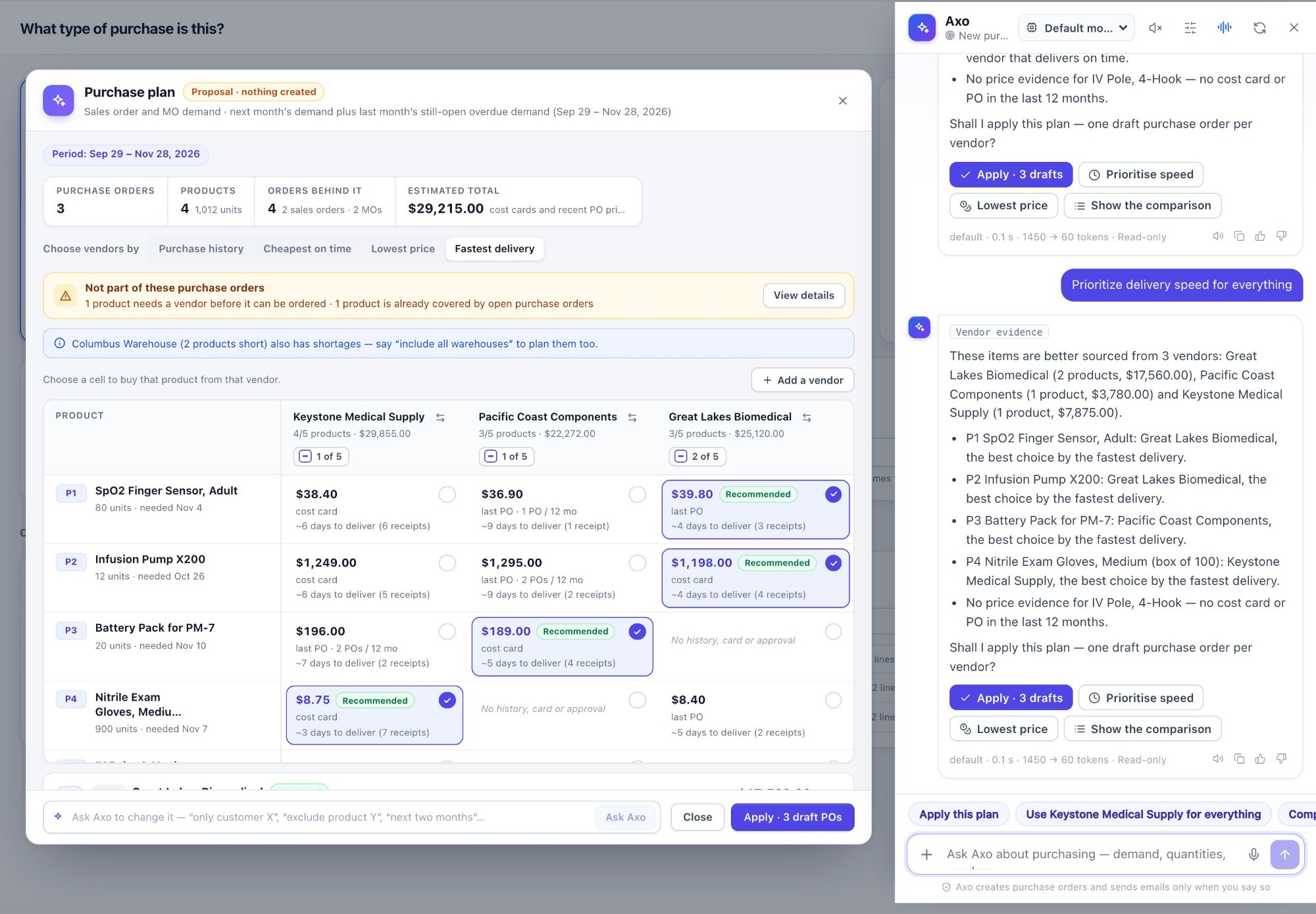
| You | Prioritize delivery speed for everything |
| Axo | These items are better sourced from 3 vendors: Great Lakes Biomedical (2 products, $17,560.00), Pacific Coast Components (1 product, $3,780.00) and Keystone Medical Supply (1 product, $7,875.00). Shall I apply this plan one draft purchase order per vendor? |
18. From plan to purchase orders
Apply the plan as draft purchase orders, check them, and let Axo create them when you are happy.
Apply the plan
Select Apply in the plan or in Axo’s reply, or answer Axo’s question in your own words “Looks good, apply it”. Each vendor’s draft opens in the workspace as its own vendor tab. Nothing is saved yet.
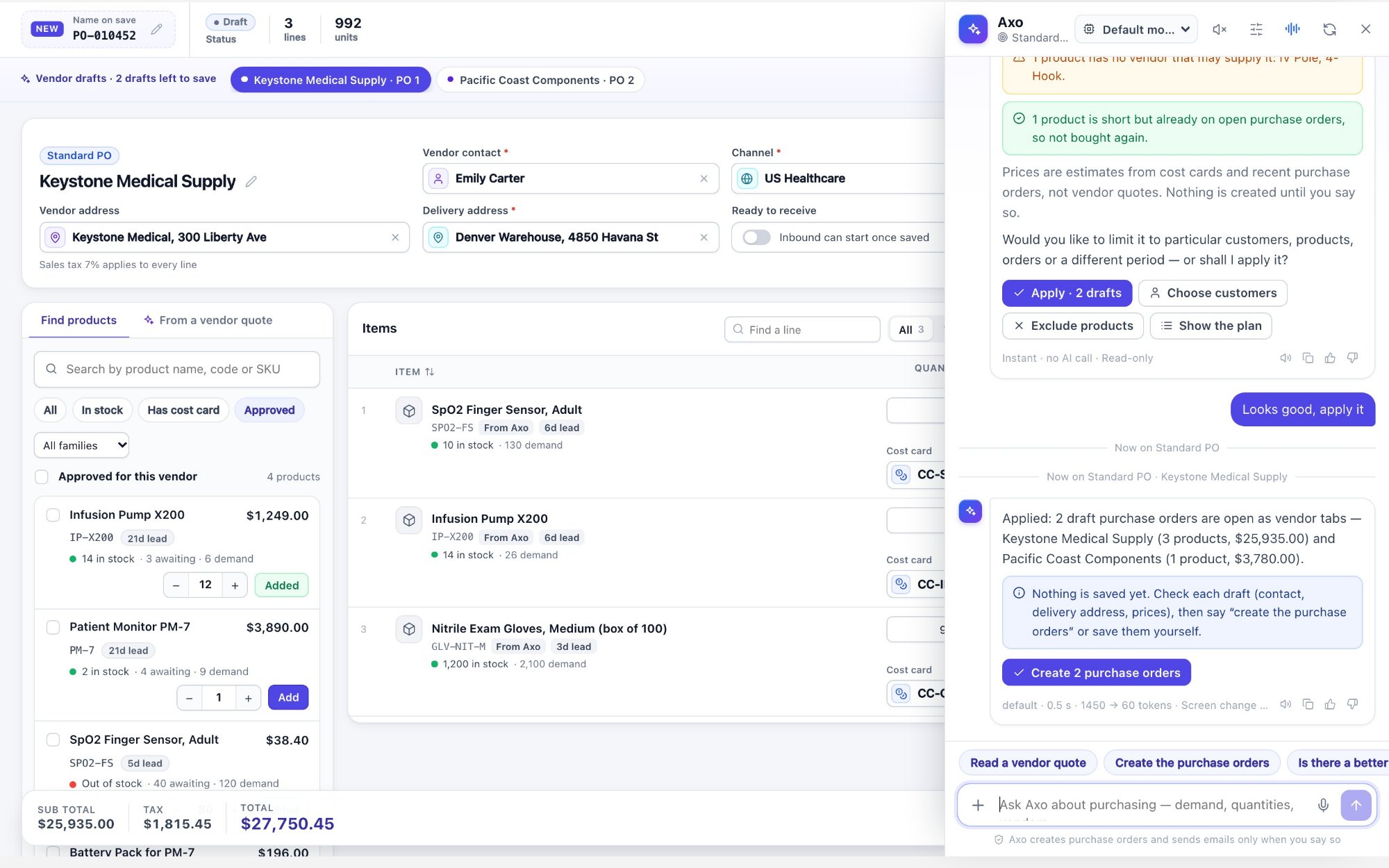
Check and change the drafts
Each vendor tab is a complete purchase order: check the contact, delivery address and prices, and change anything as described in Part 2 or ask Axo:
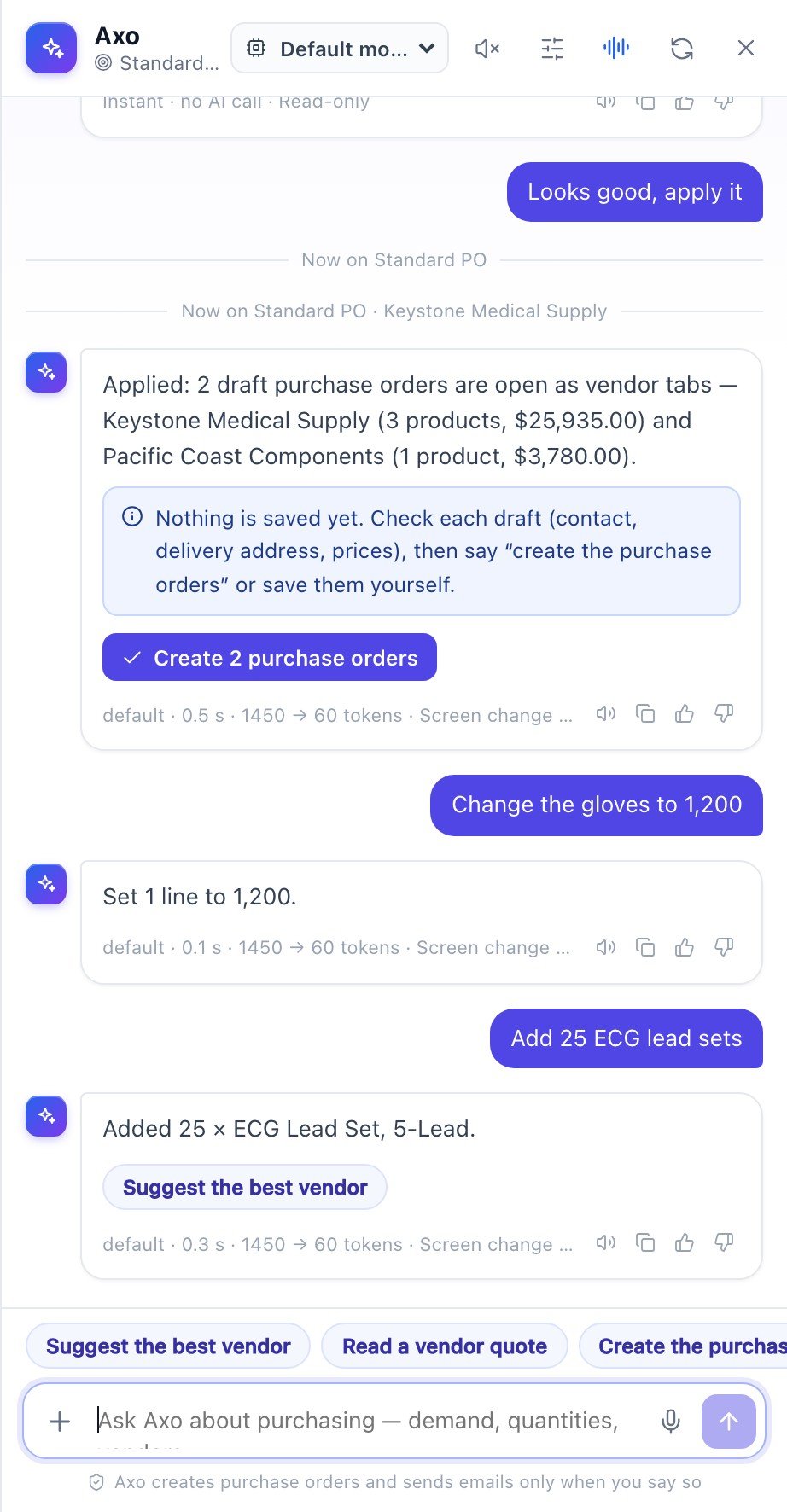
| You | Change the gloves to 1,200 |
| Axo | Set 1 line to 1,200. |
| You | Add 25 ECG lead sets |
| Axo | Added 25 × ECG Lead Set, 5-Lead. |
| Say or type | What changes |
|---|---|
| “Remove line 3” | Removes lines. |
| “Deliver by November 20” | Sets the expected date. |
| “Receive it in Columbus Central DC” | Sets the receiving warehouse. |
| “Show the Pacific Coast draft” | Switches vendor tab. |
Create the purchase orders
Say “Create the purchase orders” or select Create N purchase orders in Axo’s reply. Axo lists what it will create and waits for you to confirm.
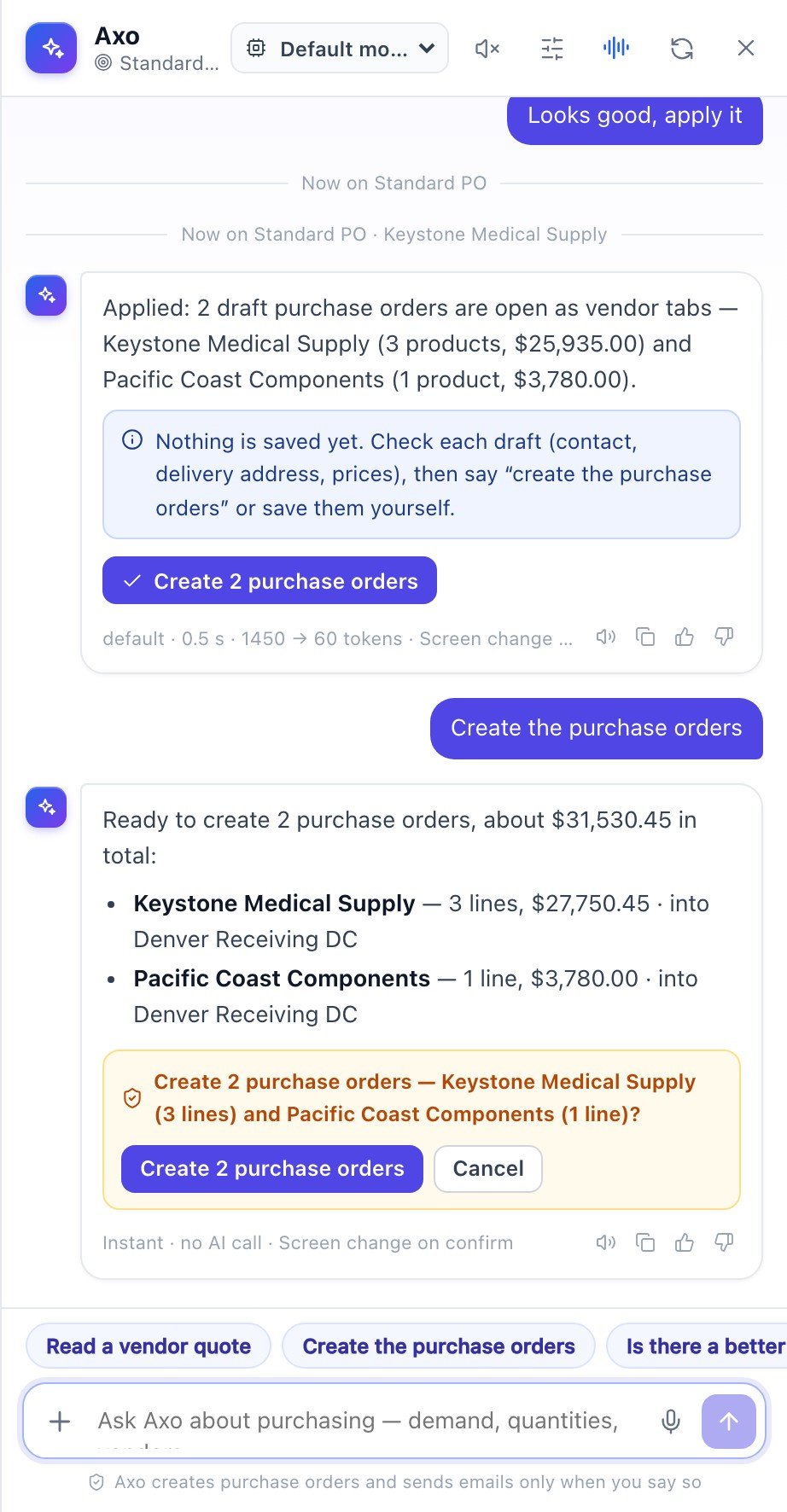
| You | Create the purchase orders |
| Axo | Ready to create 2 purchase orders, about $31,530.45 in total: • Keystone Medical Supply 3 lines, $27,750.45 · into Denver Receiving DC • Pacific Coast Components 1 line, $3,780.00 · into Denver Receiving DC Create 2 purchase orders · Cancel |
Confirm with the button, or reply in your own words.
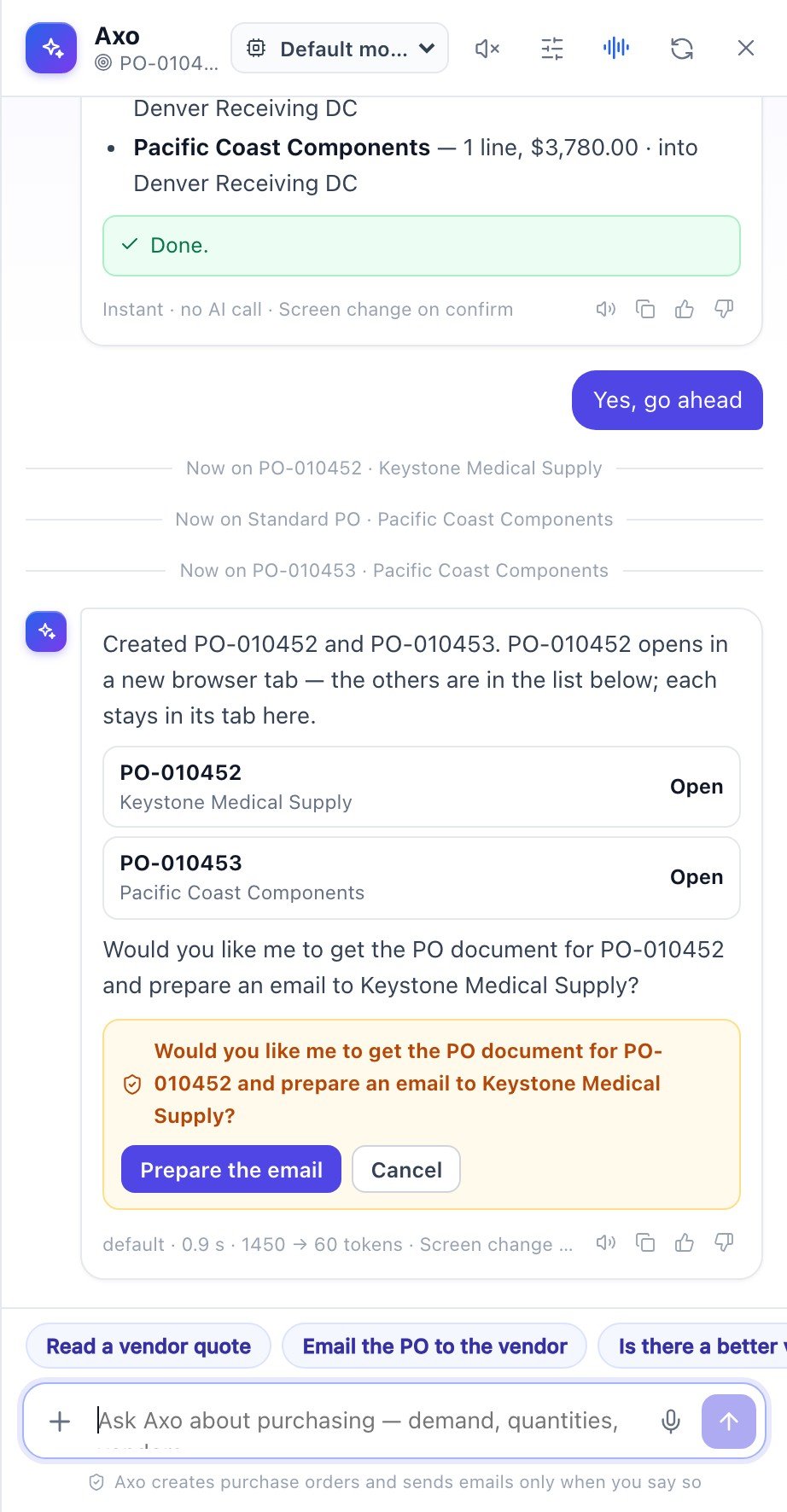
| You | Yes, go ahead |
| Axo | Created PO-010452 and PO-010453. PO-010452 opens in a new browser tab the others are in the list below; each stays in its tab here. Would you like me to get the PO document for PO-010452 and prepare an email to Keystone Medical Supply? Prepare the email · Cancel |
Each purchase order is saved through the screen’s normal save. Select Open beside a purchase order to open it in a new tab. Axo then offers to email the first one to its vendor (Chapter 20).
19. Work on a purchase order with Axo
Ask Axo about the purchase order on screen whether you built it yourself or Axo prepared it.
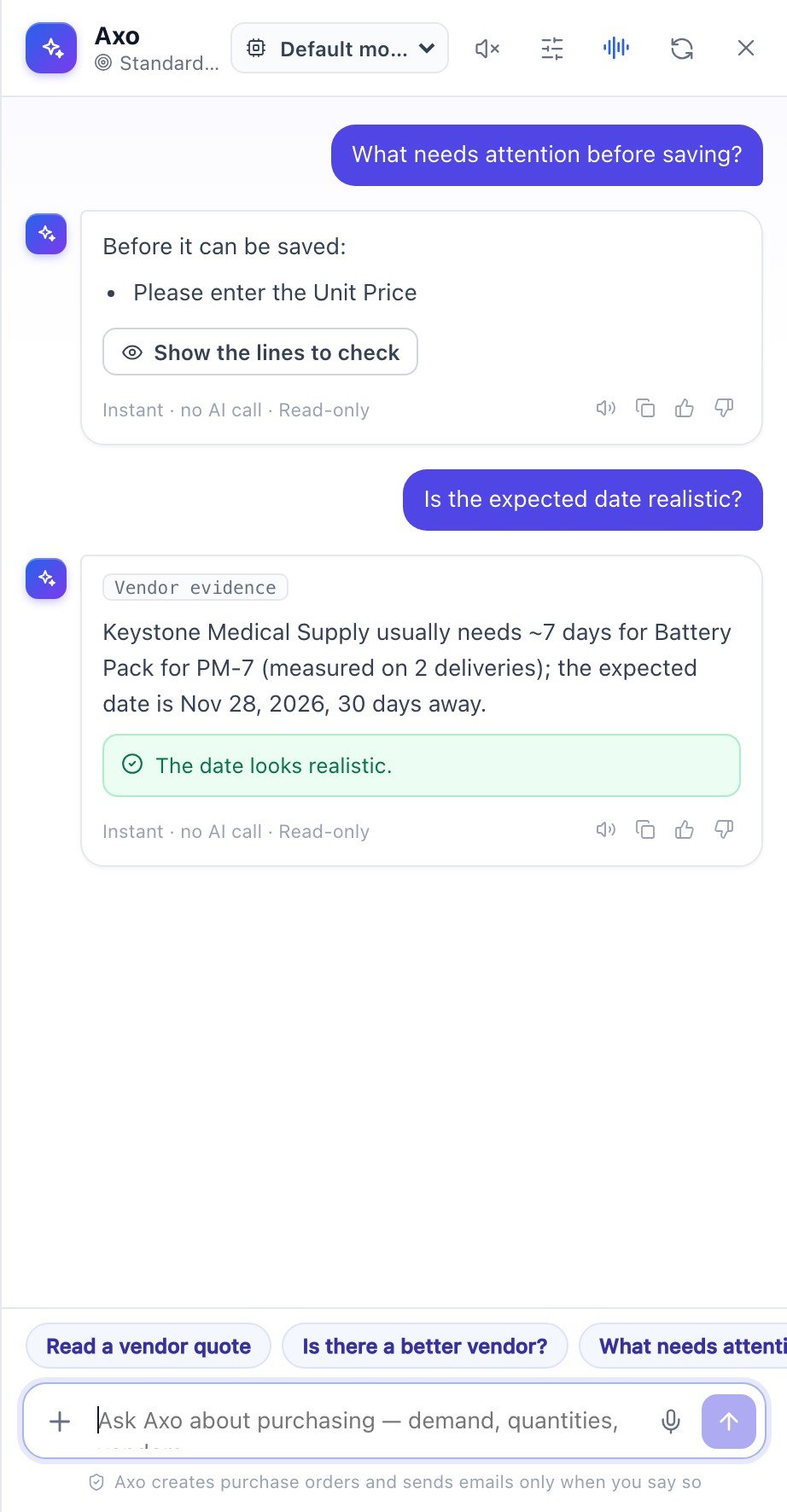
| You | What needs attention before saving? |
| Axo | Before it can be saved: • Please enter the Unit Price Show the lines to check |
| You | Is the expected date realistic? |
| Axo | Keystone Medical Supply usually needs ~7 days for Battery Pack for PM-7 (measured on 2 deliveries); the expected date is Nov 28, 2026, 30 days away. The date looks realistic. |
If the date isn’t realistic, Axo says how many days short it is and offers to find a faster vendor.
Is there a better vendor?
On a purchase order with a vendor, ask “Is there a better vendor than the one I chose?”. Axo compares the vendor with the alternatives for every line and shows the possible saving. If switching pays, it proposes splitting the order into one draft per vendor and applies it only if you agree.
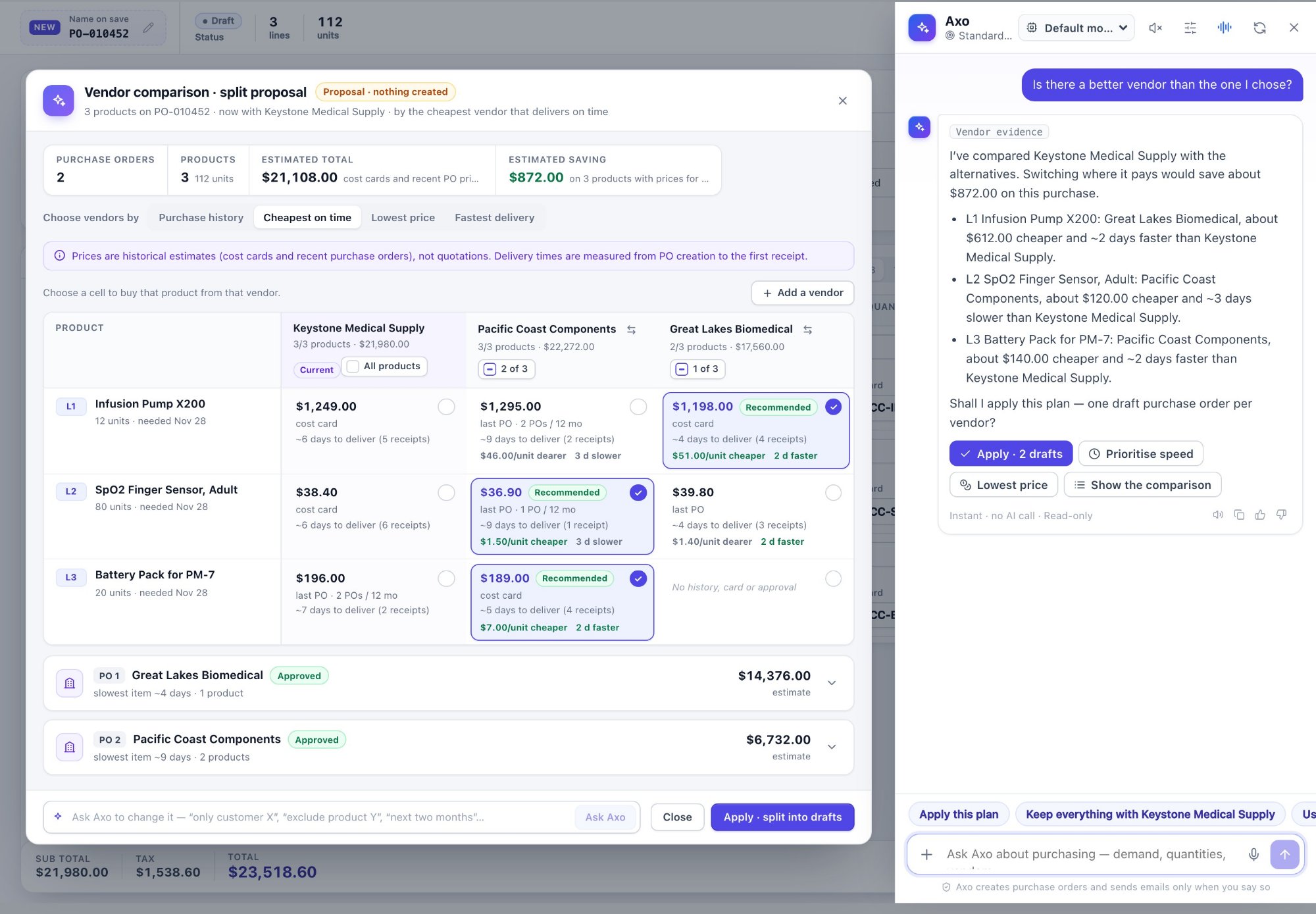
| You | Is there a better vendor than the one I chose? |
| Axo | I’ve compared Keystone Medical Supply with the alternatives. Switching where it pays would save about $872.00 on this purchase. • L1 Infusion Pump X200: Great Lakes Biomedical, about $612.00 cheaper and ~2 days faster than Keystone Medical Supply. • L2 SpO2 Finger Sensor, Adult: Pacific Coast Components, about $120.00 cheaper and ~3 days slower than Keystone Medical Supply. • L3 Battery Pack for PM-7: Pacific Coast Components, about $140.00 cheaper and ~2 days faster than Keystone Medical Supply. Shall I apply this plan one draft purchase order per vendor? |
More things to ask
| Say or type | What Axo does |
|---|---|
| “Summarize this purchase order” | The vendor, warehouse, expected date, lines, units and total, plus anything that needs attention. |
| “Suggest the best vendor” | Recommends a vendor for the products on a purchase order with no vendor yet. |
| “Set L2 to 60” · “Change the gloves to 1,200” | Changes quantities. Lines are numbered L1, L2… from the top. |
| “Remove the products with no quantity” | Removes lines that still have no quantity. |
| “Save it” | Saves the purchase order on screen, after you confirm. |
| “Start a drop ship purchase order” | Starts a new purchase order of that type, after asking about unsaved work. |
| “Open PO-010388” | Opens a saved purchase order’s record in a new tab. |
20. Send the purchase order to the vendor
Axo gets the PO document, drafts the email, lets you change it in your own words, and sends it only when you say so.
After a purchase order is saved, accept Axo’s offer or say “Email the PO to the vendor”. For an earlier purchase order, name it: “Email PO-010388 to the vendor”.
Axo opens the PO document and drafts an email to the vendor contact, with the document attached.
Ask for any changes “Make it friendlier”, “Make it shorter”, “Ask them to confirm availability and the earliest delivery date”, “Send it to orders@…” or edit the email yourself.
Say “Send it”, or select Send.
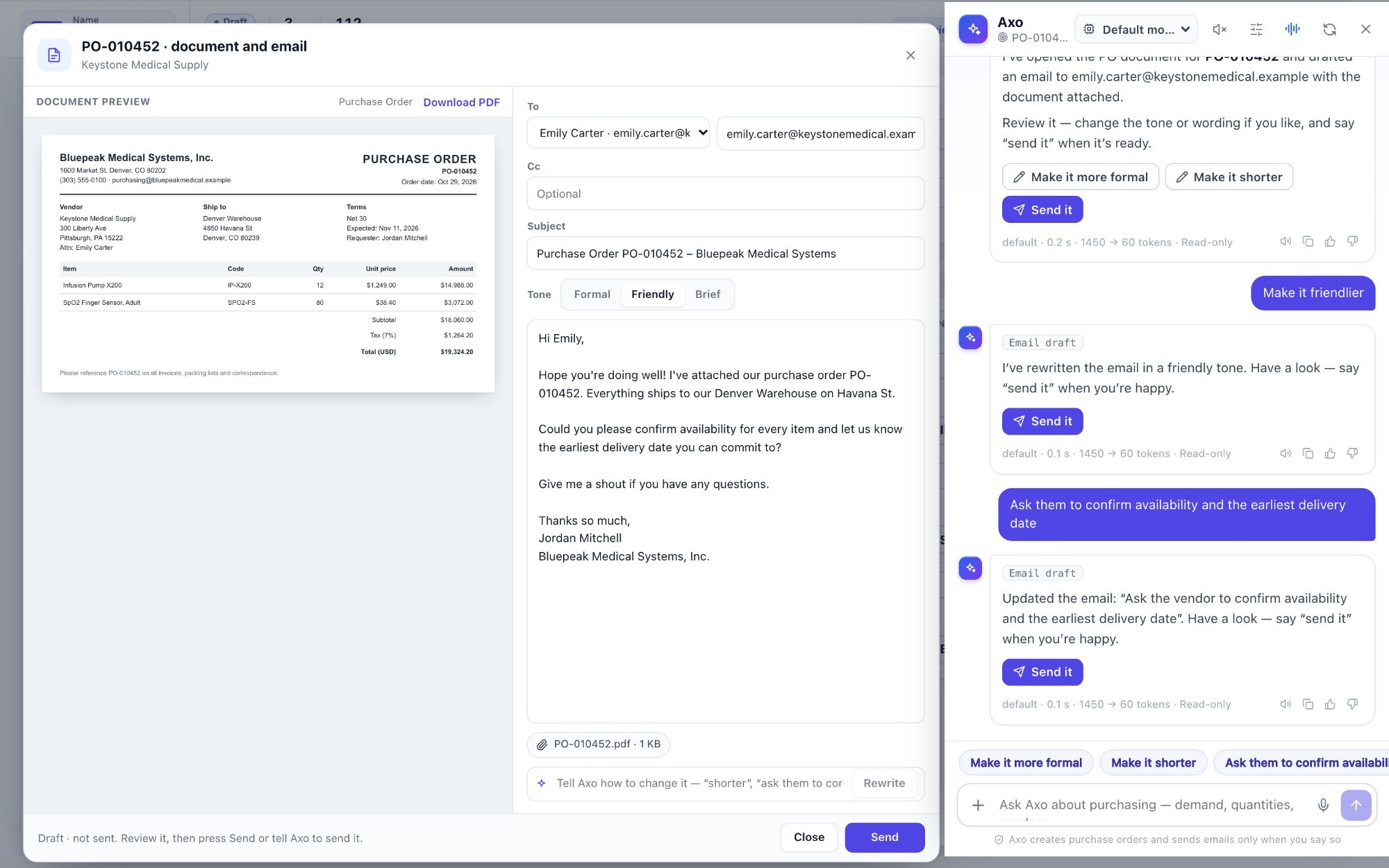
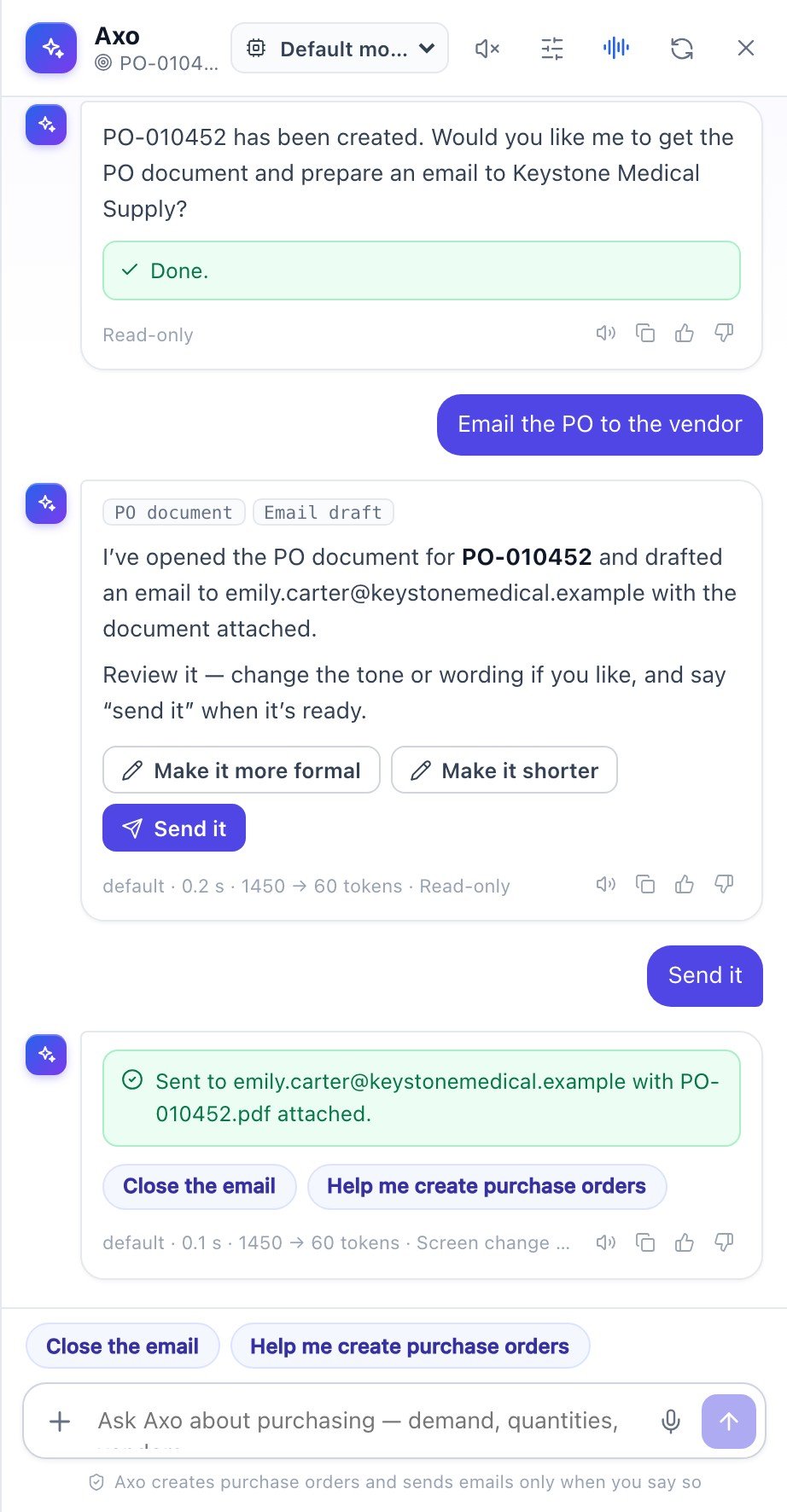
| You | Email the PO to the vendor |
| Axo | I’ve opened the PO document for PO-010452 and drafted an email to emily.carter@keystonemedical.example with the document attached. Review it change the tone or wording if you like, and say “send it” when it’s ready. |
| You | Send it |
| Axo | ✓ Sent to emily.carter@keystonemedical.example with PO-010452.pdf attached. |
21. History, quotes and everyday questions
Look up how vendors have performed, find recent purchase orders, and turn a supplier quote into lines.
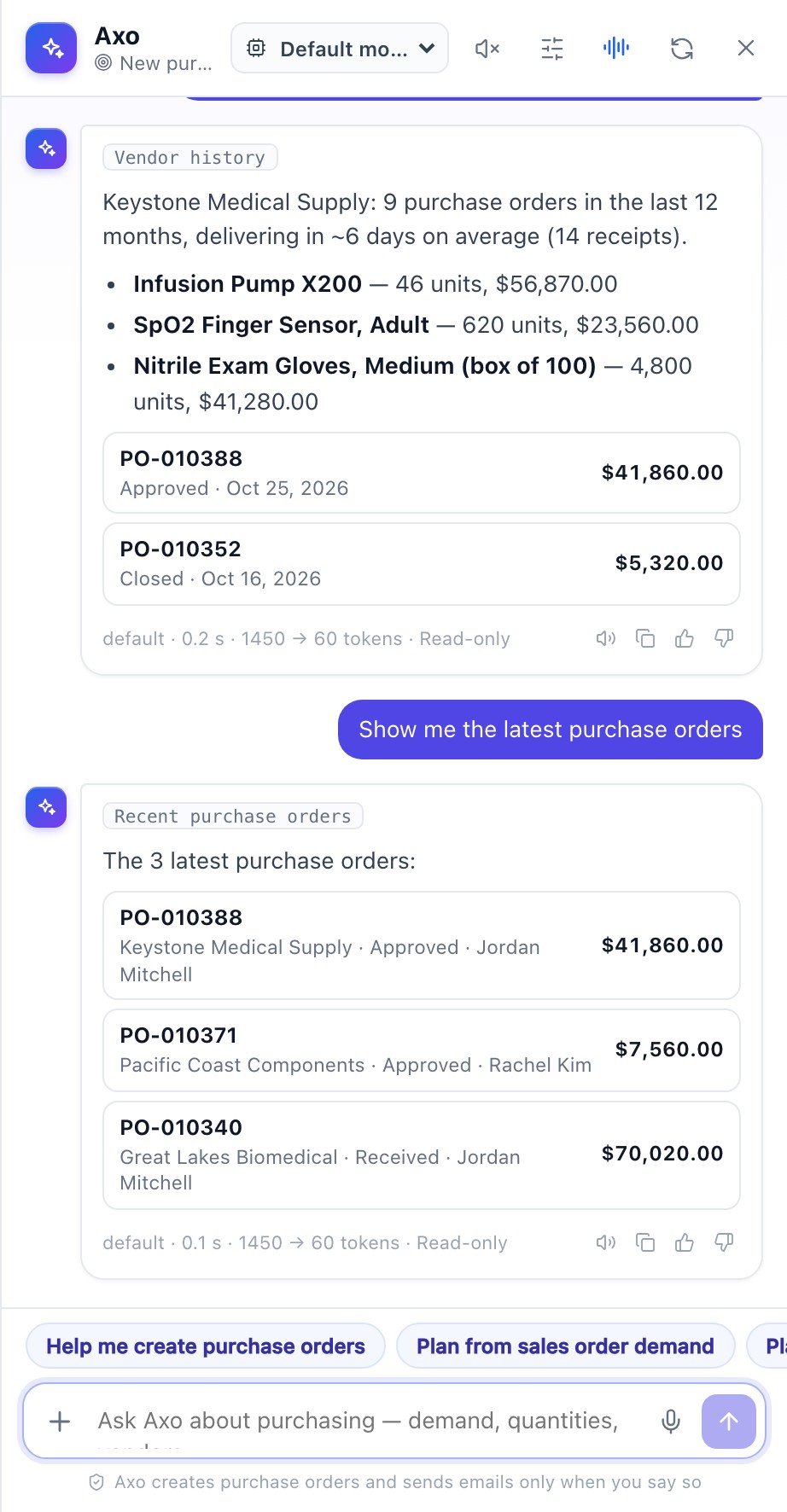
| You | How has Keystone Medical Supply delivered for us? |
| Axo | Keystone Medical Supply: 9 purchase orders in the last 12 months, delivering in ~6 days on average (14 receipts). • Infusion Pump X200 46 units, $56,870.00 • SpO2 Finger Sensor, Adult 620 units, $23,560.00 • Nitrile Exam Gloves, Medium (box of 100) 4,800 units, $41,280.00 |
| You | Show me the latest purchase orders |
| Axo | The 3 latest purchase orders: PO-010388, PO-010371, PO-010340 each with vendor, status, creator and total. |
Select a purchase order card to open it in a new tab. You can also ask for “my recent purchase orders”, or recent purchase orders for a vendor or a product.
Read a vendor quote
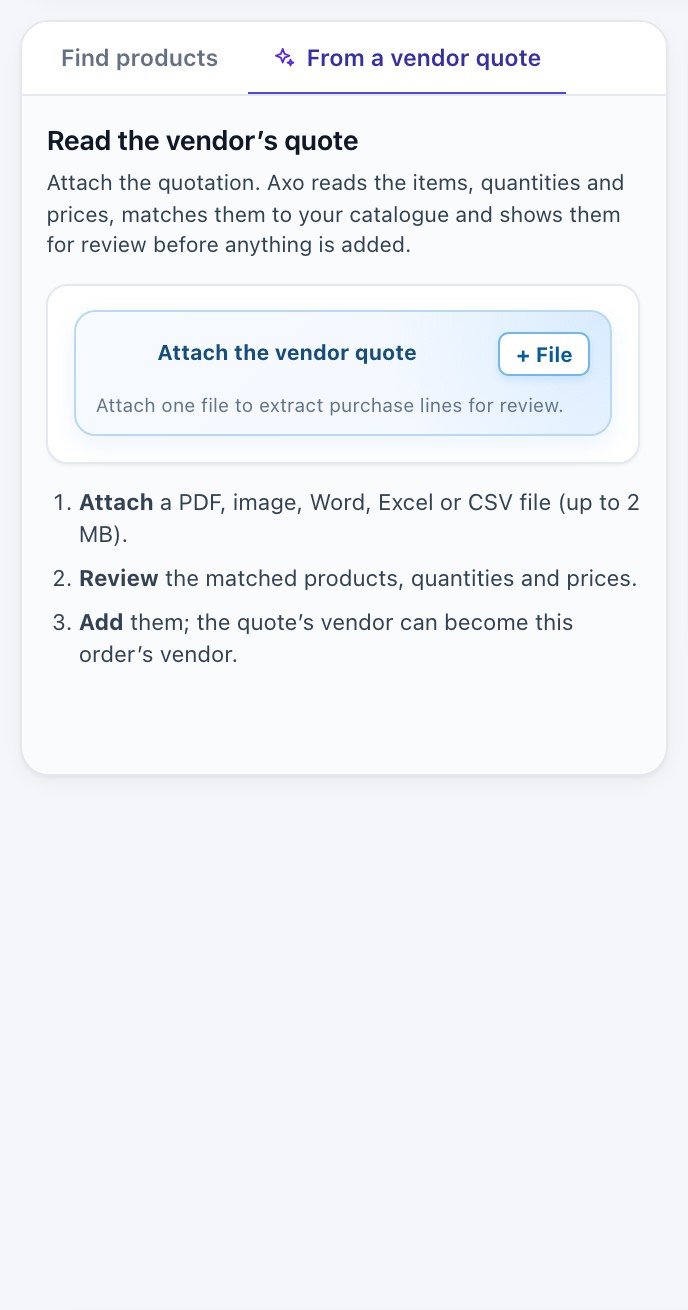
Axo reads a quotation a PDF, image, Word, Excel or CSV file up to 2 MB and turns it into purchase lines for you to review. Nothing is added until you confirm.
On the start page, select + File under Read a vendor quote or, in the workspace, open the From a vendor quote tab in the Add products panel. In Axo Chat or Axo Voice, select + in the message box and attach the quote as a PDF, PNG or JPEG.
Choose the quotation file. Axo reads the vendor, the items, the quantities and the prices.
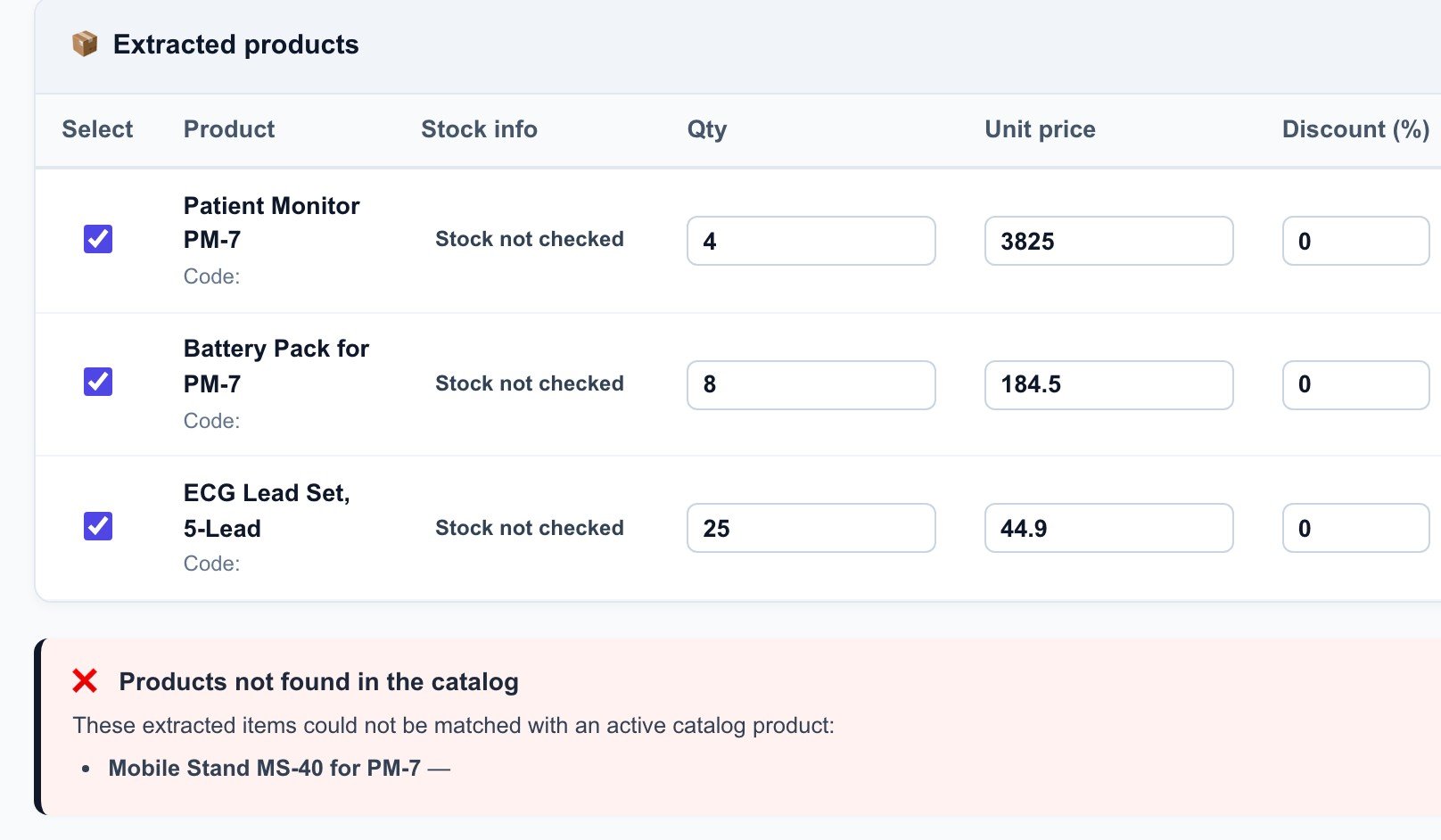
Review the extracted products: untick any you don’t want, and correct quantities, unit prices and discounts.
Select Add selected to purchase order. The quote’s vendor can become the purchase order’s vendor.
Items Axo can’t match to an active product in your catalog are listed under Products not found in the catalog, so you can add them as custom items or set them up first.
Misheard or misspelled? Axo corrects it
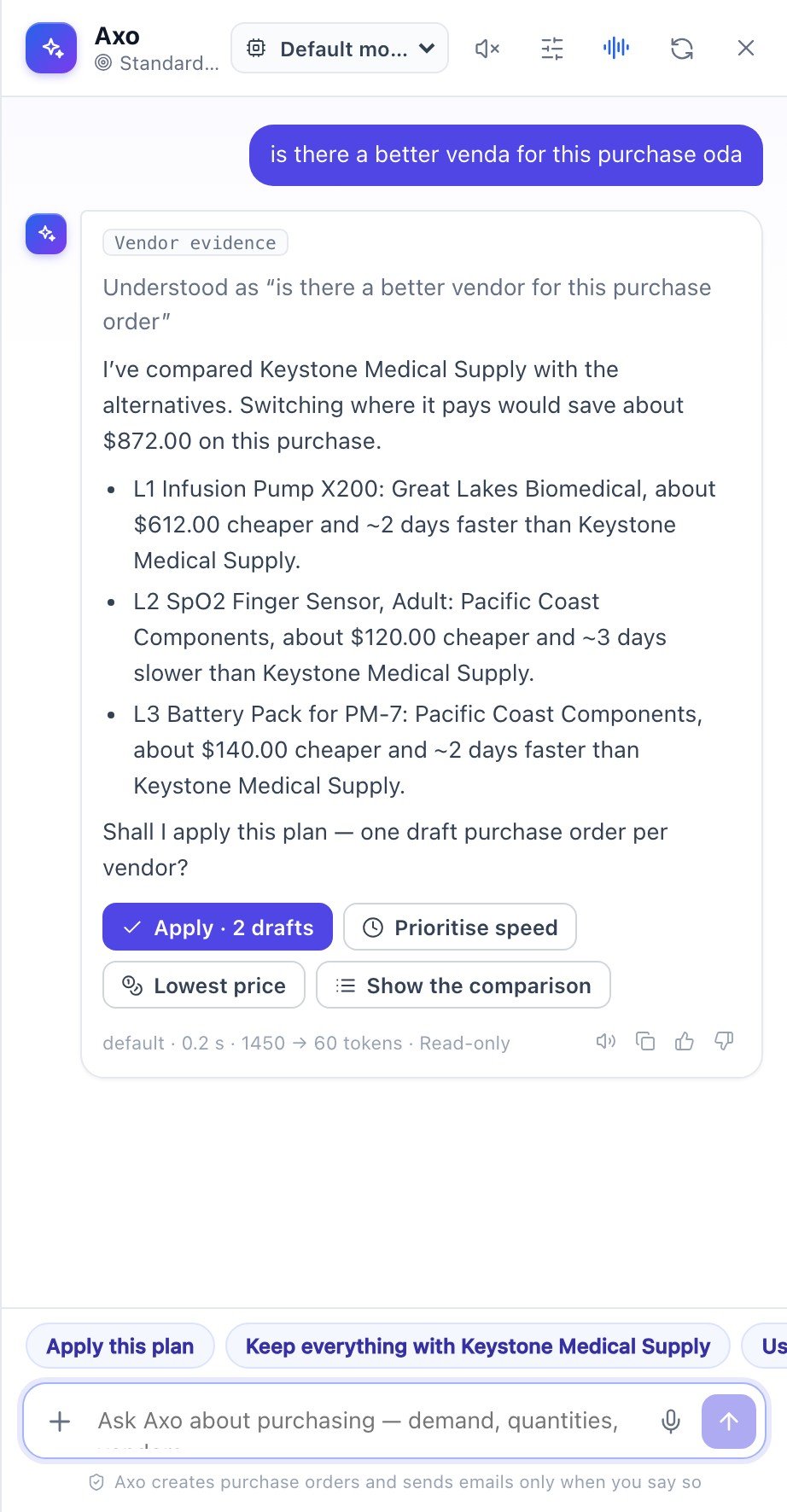
| You | is there a better venda for this purchase oda |
| Axo | Understood as “is there a better vendor for this purchase order” I’ve compared Keystone Medical Supply with the alternatives. Switching where it pays would save about $872.00 on this purchase. |
Typos and misheard words especially when dictating are corrected using purchasing terms and the names on your screen, and the reply shows Understood as with the corrected request.
When Axo can’t help
If you ask for a purchasing action Axo can’t do, it says so plainly and lists what it can help with. Requests that have nothing to do with purchasing are politely declined.
22. Axo Voice
Run your purchasing hands-free: talk to Axo, hear the answer, and confirm by voice.
Start a voice session
Select the blue microphone button at the bottom right. Allow microphone access if your browser asks.
Axo greets you by name and starts listening.
Say what you need for example “Plan my purchases from sales order demand”. Axo sends your request when you stop speaking.
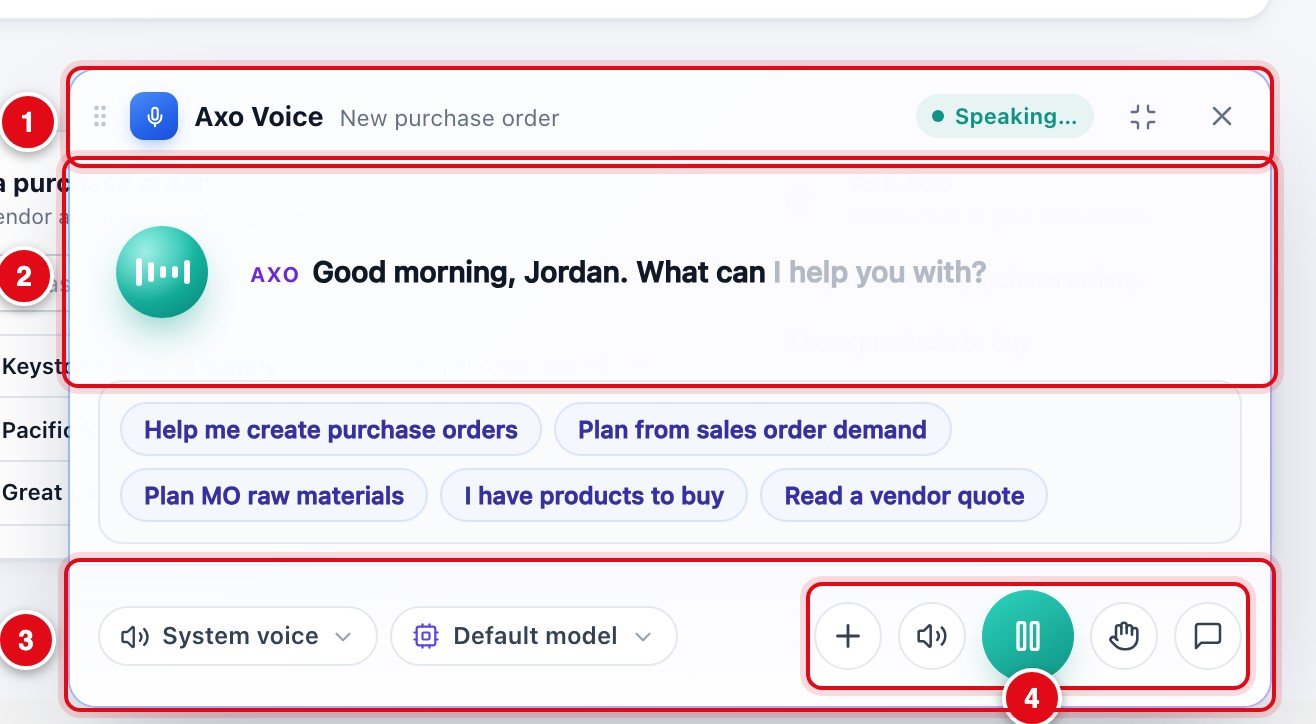
| # | Item | What it does |
|---|---|---|
| 1 | Header | Axo’s state Listening…, Thinking…, Speaking… or Paused plus minimise and close. Drag the handle to move the panel. |
| 2 | Conversation | What you said and what Axo is saying, written out as it speaks. |
| 3 | Voice and model | Choose Axo’s voice and speaking speed, and the AI model. |
| 4 | Controls | Add a file, mute Axo’s voice, Pause / Resume listening (the large button), interrupt Axo, and open the conversation in Axo Chat. |
While Axo is speaking
Axo doesn’t listen while it is speaking, so it never hears itself through your speakers. To cut an answer short, select Interrupt Axo or press Esc; select the large button to pause listening, and again to resume. Selecting a suggestion while paused still gets a spoken answer.
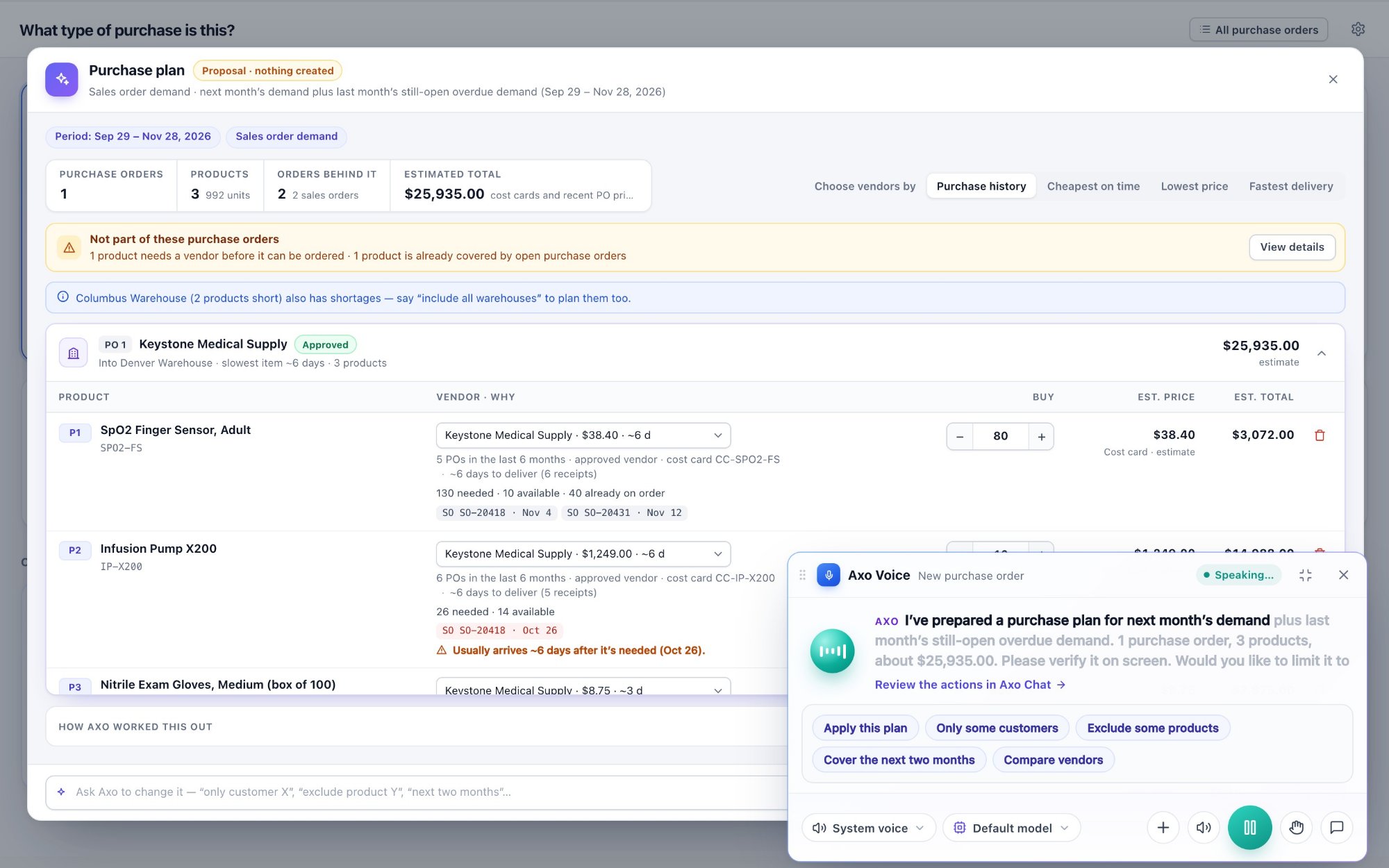
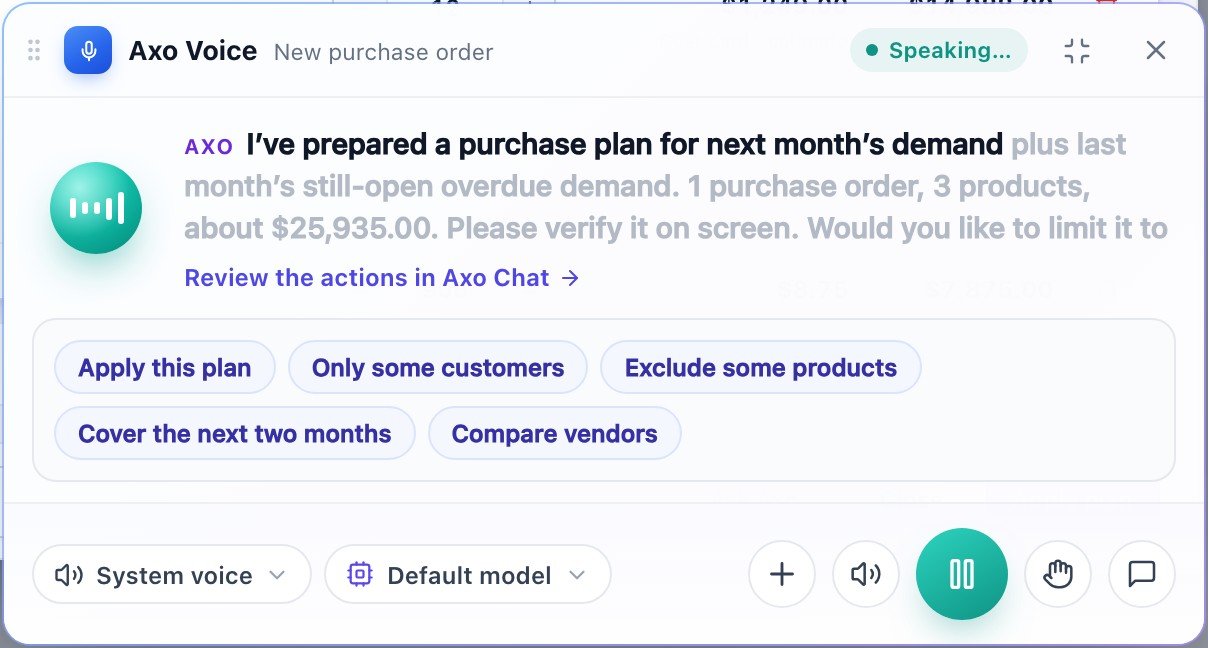
Spoken answers give counts and the most important points rather than long lists. Record numbers appear in the transcript exactly as written, such as PO-010452, while Axo reads them aloud. For the full details and every button, select Review the actions in Axo Chat Axo finishes what it was saying while the chat opens.
Things to say
| Goal | Say |
|---|---|
| Start planning | “Help me create purchase orders” · “Plan MO raw materials” |
| Narrow the plan | “Only for Bayview Health Partners” · “Cover the next two months” |
| Choose vendors | “Prioritize delivery speed” · “Use Great Lakes Biomedical for the pumps” |
| Confirm | “Yes, apply it” · “Go ahead and create them” · “Not yet” |
| Check the order | “What needs attention?” · “Can it arrive on time?” |
| Email the vendor | “Email the PO to the vendor” · “Make it shorter” · “Send it” |
| Leave unsaved work | Answer “keep it”, “discard it” or “stay” when Axo asks |
23. The AI Purchase Planner
A one-click purchasing plan from open demand, per warehouse and vendor without a conversation.
Select AI Purchase Planner in the top bar of the workspace, or Open planner under Build from open demand on the start page.
Set the Demand window: how far back overdue demand counts and how far ahead upcoming demand counts.
Choose the warehouse tab to plan. Each shows its shortage count.
Review each vendor’s draft: the products, when they are needed, demand, stock, the order quantity and price. Change quantities and prices as needed, or select Analyze on a product for its purchase insights.
Select Apply purchase plan.
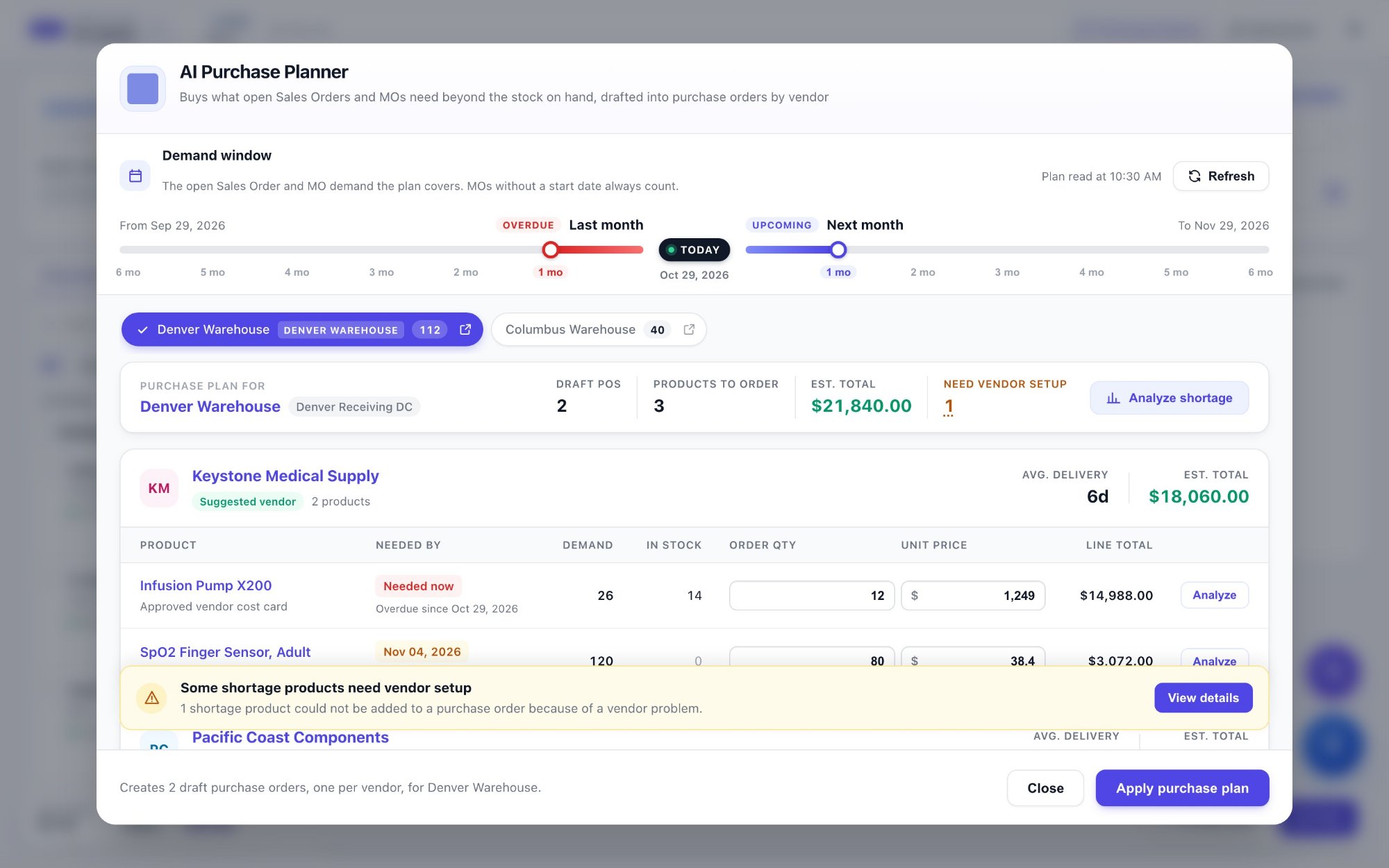
The plan opens as vendor tabs in the workspace one draft purchase order per vendor. Check and save each tab; the tab bar shows how many drafts are left to save.
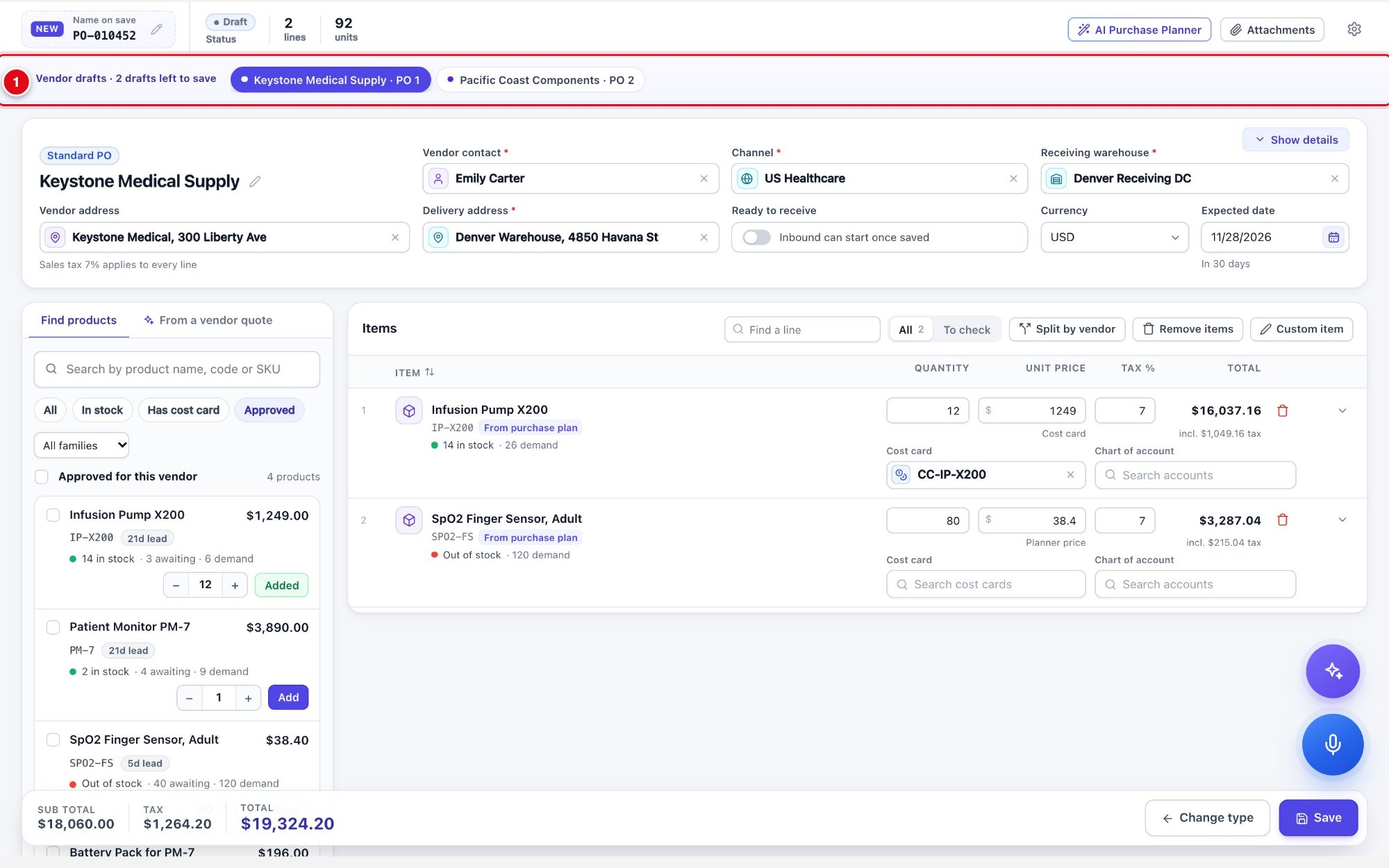
| # | Item | What it does |
|---|---|---|
| 1 | Vendor draft tabs | One tab per vendor draft (Keystone Medical Supply · PO 1, Pacific Coast Components · PO 2). Lines from the plan are tagged From purchase plan. |
Part 4 · Reference
Quick references, answers to common questions and terms used in this guide.
24. Quick reference
The most common tasks at a glance.
| I want to… | On the screen | With Axo |
|---|---|---|
| Start a purchase order | Purchase Orders › New › choose the type › Continue | “Start a standard purchase order” |
| Plan from demand | AI Purchase Planner › Apply purchase plan | “Plan from demand” · “Plan from sales order demand” |
| Buy specific products | Add products › search › Add | “I have products to buy” |
| Read a vendor quote | From a vendor quote › attach | Attach the quote in Axo Chat |
| Buy from several vendors | Split by vendor › choose a vendor per item › Apply | “Is there a better vendor?” › apply the split |
| Compare vendors | Open a line › Alternate vendors | “Is there a better vendor?” |
| Check before saving | The To check filter | “What needs attention?” |
| Check the delivery date | The lead-time warning under the header | “Is the expected date realistic?” |
| Save | Save or ⌘ / Ctrl + S | “Create the purchase orders” then confirm |
| Email the vendor | Review & send to vendor › Send | “Email the PO to the vendor” › “Send it” |
25. Frequently asked questions
Answers to the questions purchasing teams ask most.
| Question | Answer |
|---|---|
| I can’t see Axo, the AI Purchase Planner, Read a vendor quote or Review & send to vendor. | These appear only when Axo AI is enabled for you. Ask your Axolt administrator. |
| Why can’t I change this purchase order? | Only Draft purchase orders can be changed. Others open read-only. |
| Why won’t my purchase order save? | Axolt tells you what is missing. Look for outlined fields, the To check filter, and a red count on Show details. Lines with an unapproved vendor must be moved with Prepare approved vendor POs. |
| A product shows no price. | It has no cost card for this vendor. Type the price, or choose a cost card on the line. |
| Why did my prices change when I changed the vendor? | Lines priced from the old vendor’s cost cards are repriced from the new vendor’s. Prices you typed stay. |
| Can I buy the items on one purchase order from different vendors? | Yes select Split by vendor in the Items header, choose a vendor for each item and select Apply. Each vendor gets its own purchase order tab (Chapter 7). |
| Can I name the purchase order myself? | Yes select the pencil beside the name in the top bar (Chapter 5). |
| Where did my saved purchase order go? | It opened in a new browser tab, and the workspace stays on it. If your browser blocked the new tab, select Open in the confirmation message. |
| Will Axo create or send anything on its own? | No. Axo creates purchase orders and sends emails only after you confirm. |
| Are Axo’s prices quotes? | No. They are estimates from cost cards and recent purchase orders. |
| Axo Voice doesn’t hear me. | Allow microphone access in your browser, check that Axo isn’t paused, and use a headset in noisy places. |
| How much AI have I used? | Settings › Axo token usage shows usage per AI model and what is left. |
26. Glossary
Purchasing terms as Axolt uses them.
| Term | Meaning |
|---|---|
| Approved vendor | A vendor approved to supply a product. Some products may only be bought from an approved vendor. |
| Axo | Axolt’s purchasing assistant, in Axo Chat (typed) and Axo Voice (spoken). |
| Channel | The sales channel a purchase belongs to. |
| Cost card | A vendor’s agreed price for a product, used to price purchase order lines. |
| Demand window | The period of open demand a plan covers, including overdue demand still open. |
| Drop ship | A purchase the vendor delivers straight to your customer. |
| Lead time | How long a vendor takes to deliver. Axo measures it from purchase order creation to first receipt. |
| MO raw materials | Materials needed by manufacturing orders. |
| Receiving warehouse | The distribution center where the goods are received. |
| RTV | Return to vendor: sending received goods back. |
| Split by vendor | Choosing a vendor for each item on a purchase order, then moving each vendor’s items to its own purchase order tab. |
| Vendor draft tab | One of several draft purchase orders on screen at once, one per vendor. |
Need more help?
Contact your Axolt administrator for help with access or the settings mentioned in this guide. For a question about a specific purchase order, ask Axo many of the questions this guide answers can also be asked directly in Axo Chat or Axo Voice, on the screen itself.
Where to look next
Was this article helpful?